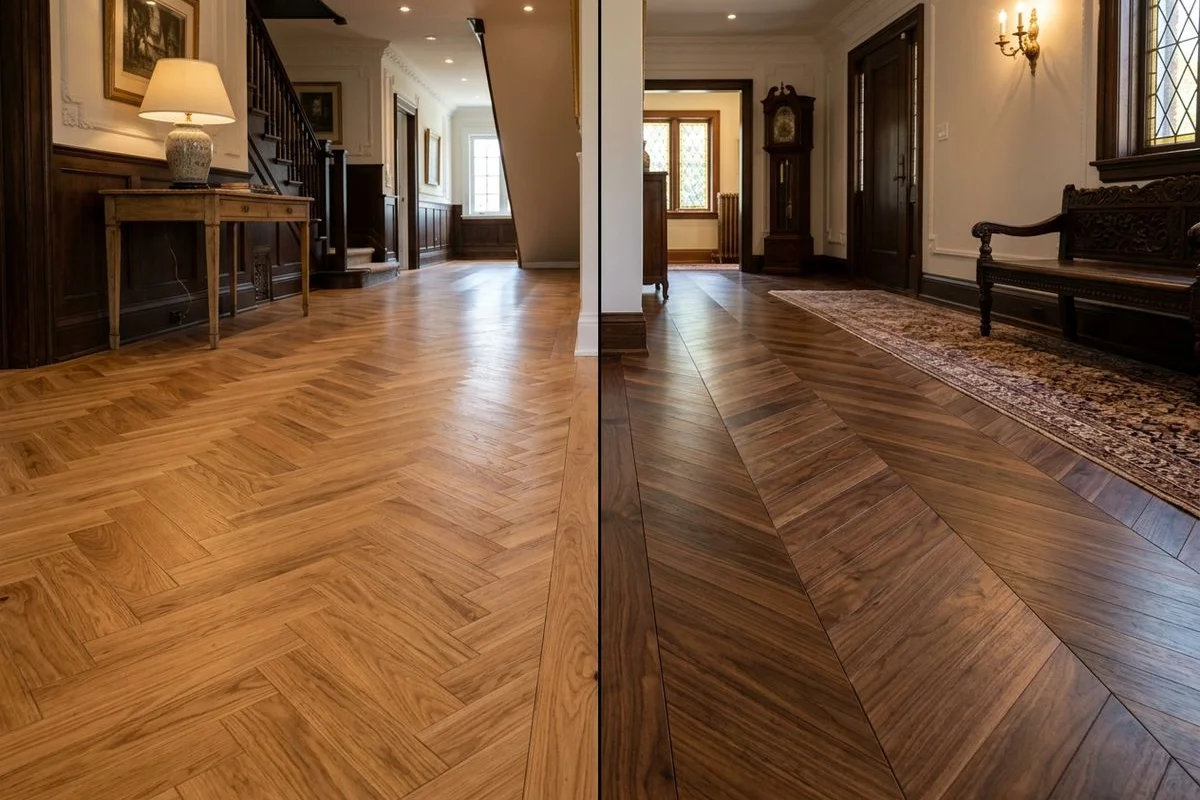
Two patterns, two very different visual languages
Both herringbone and chevron belong to the same family of geometric hardwood layouts, but they produce entirely different results on the floor. Choosing between them is not purely a matter of taste - it involves understanding how each pattern is constructed, which room proportions each suits, and where the cost difference actually comes from.
Toronto Quality Wood Flooring installs both patterns regularly across Forest Hill, Rosedale, Lawrence Park, and Leaside. European White Oak dominates both styles in the current GTA market, but the visual character of each pattern differs sharply. This guide covers the structural differences, historical roots, species recommendations, room-fit guidance, and a full cost comparison so you can make an informed decision before committing.
For a full overview of what geometric floor installation involves, see our custom pattern flooring page, or read the step-by-step breakdown in our custom pattern installation process guide.
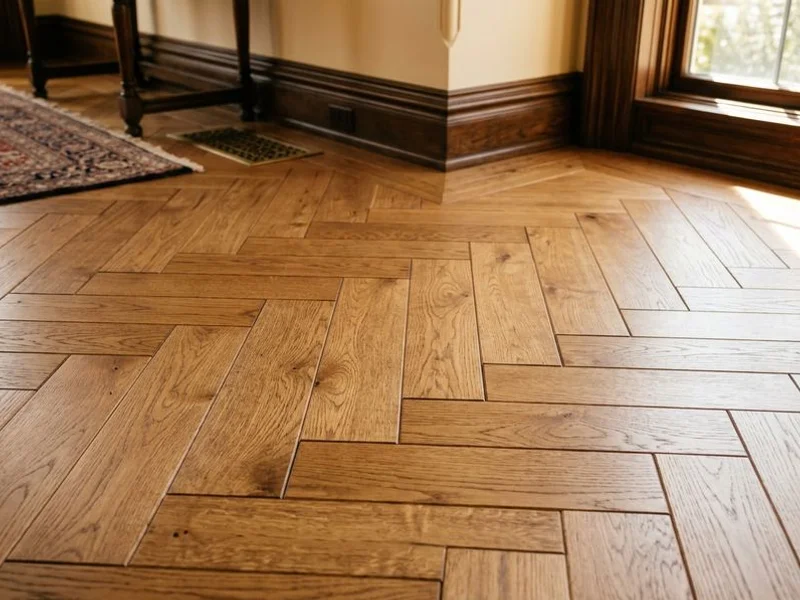
What herringbone actually is
Herringbone uses rectangular planks cut square at both ends. Each plank is laid at 90 degrees to the one beside it, alternating direction row by row. The result is a broken zigzag - the V-shapes point alternately up and down across the floor, creating what looks like the spine of a fish. The term “herringbone” comes directly from that fish-bone appearance.
Historically, this pattern dates to Roman stone pavements and appeared widely in French oak parquetry from the 17th century onward. In Toronto specifically, herringbone is the dominant pattern in the original parquetry of heritage entrance halls in Rosedale and Forest Hill - homes built between 1900 and 1940 that still carry their original floors today. The pattern reads as traditional, warm, and grounded in craft.
The block size changes how the pattern reads in the room. A 60mm wide block produces a fine, delicate rhythm associated with formal Victorian rooms. A 90-100mm block reads as contemporary and bold. For modern Forest Hill renovations where the architecture is updated but the bones are heritage, 90mm blocks in European White Oak are the most requested specification we see.
Wood waste for herringbone runs 3-5% above what a straight-lay installation would require. The cuts are standard square rips, so there is minimal setup overhead for each cut.
What chevron actually is
Chevron uses planks cut at a precise angle at both ends - typically 45 degrees, though 60 degrees is also used. When two planks meet, their angled ends align to form a continuous, unbroken V-shape pointing in one direction across the floor. The pattern has a clean arrowhead quality that draws the eye toward the room’s focal wall.
The term “chevron” comes from the military stripe used on rank insignia - a single, uniform V-shape. As a flooring pattern, chevron is largely a 20th century revival, popularised by contemporary French and Belgian Oak installations. It reads as modern and directional rather than traditional and layered.
The precision required for chevron is significantly higher than for herringbone. Both ends of every plank must be cut at exactly the same angle - if the angle varies even slightly from board to board, the continuous V-line at the centre of the floor will drift and waver. This demands a table saw with a digital angle fence and careful machine setup at the start of every run of cuts.
Wood waste for chevron runs 5-8% above straight-lay. The angled ends generate more offcuts per board than square cuts do.
How each pattern reads in different rooms
This is where the practical decision often gets made. Herringbone and chevron interact differently with room proportions.
Herringbone in narrow rooms: The alternating zigzag creates a visual “stepping” effect that reads across the width of the space, making narrow rooms feel wider. This is part of why herringbone dominated the entrance halls of Edwardian Toronto homes - those halls are typically long and narrow, and the pattern counteracted the tunnel effect.
Chevron in wide or square rooms: The continuous arrowhead pulls the eye forward along the room’s long axis, creating a sense of depth and drama. In open-concept main floors or large square living rooms, chevron reads as more dynamic and architectural. In a narrow room, that same directional pull can make the space feel even more confined.
Species that suit herringbone well: European White Oak (by far the most common in the GTA - its grain works with the alternating block direction), American Black Walnut (particularly in Forest Hill renovations where the dark tone suits heritage rooms), Ash (for modern grey-tone projects where cooler colour is the goal), and reclaimed Oak (for heritage restoration work where period-correct material matters).
Species that suit chevron well: European White Oak remains the dominant spec. The continuous V-line reads most cleanly in a wood with fine, consistent grain - wide, dramatic grain patterns can compete with the geometric line itself. Rift-sawn or quarter-sawn European Oak is often chosen specifically for chevron because the grain runs straight and supports the pattern.
Historical context
Herringbone is genuinely ancient as a paving pattern - it appears in Roman road construction and in medieval European brick and stone work. Its adaptation to wood flooring in France and the Low Countries from the 17th century onward established the version we recognise today. When these patterns arrived in Canadian residential architecture via British influence in the late 19th and early 20th centuries, herringbone came with them.
Chevron as a wood floor pattern is more recent. While the V-shape itself is ancient, its application to residential hardwood became fashionable in mid-20th century Europe and gained wider popularity through contemporary interior design from the 1980s onward. Its current prominence in Toronto renovations reflects the influence of European (particularly Belgian and French) interior design on high-end residential work here.
Cost comparison
The cost difference between the two patterns has three sources: labour rate, material waste, and cutting precision.
Labour: Herringbone runs slower than straight-lay (roughly 200-300 sq ft per day versus 400-600 for straight-lay) because every block must be positioned precisely against the datum line. Chevron runs slower still - 150-250 sq ft per day - because every cut must be verified for angle accuracy before it can be placed. Chevron labour runs 10-20% higher than herringbone for the same area.
Material waste: Herringbone: 3-5% over straight-lay. Chevron: 5-8% over straight-lay.
Cutting setup: Standard square cuts for herringbone require minimal machine setup time. Precision mitre cuts for chevron require digital angle fence setting, test cuts, and verification before production cutting begins.
| Feature | Herringbone | Chevron |
|---|---|---|
| End cut | Square (both ends) | 45° mitre (both ends, same angle) |
| Pattern direction | Alternating V (up and down) | Uniform V (one direction) |
| Wood waste | 3-5% above straight-lay | 5-8% above straight-lay |
| Labour premium | Base pattern rate | +10-20% over herringbone |
| Room feel | Classic, reads wider | Modern, reads dramatic |
| Best room size | Any, including narrow | Wide or square rooms |
| Typical GTA cost installed | $18-30/sq ft | $22-35/sq ft |
Which pattern is right for your home
The honest answer depends on two things: the architecture of the house and the proportions of the specific room.
For heritage homes in Rosedale, Cabbagetown, Summerhill, and the older parts of Forest Hill, herringbone is the period-correct choice. The pattern belonged in these homes when they were built, and reintroducing it in a renovation feels coherent rather than imposed.
For contemporary builds, renovated open-concept main floors, and spaces where a strong graphic statement is the goal, chevron suits the brief. The continuous V-line works with clean, modern architecture in the same way that herringbone works with mouldings, wainscotting, and traditional trim.
For rooms that are genuinely wide or square with a clear focal wall, chevron’s directional quality is an asset. For entrance halls, corridors, and rooms with restricted width, herringbone’s lateral visual effect works better.
Both patterns can be executed in European White Oak at any finish - from natural Rubio Monocoat oil to grey-toned Bona Traffic HD waterborne. The finish direction changes the mood of either pattern considerably.
Get your pattern quote
Toronto Quality Wood Flooring offers free in-home consultations for herringbone and chevron projects. We bring species samples, discuss block size and finish direction, and return a fixed-price written quote within 48 hours. No estimate carries surprise additions - material, subfloor prep, layout, installation, and finish are all itemised line by line.
Contact us today to book your in-home visit and see both patterns in your actual light conditions before you decide.