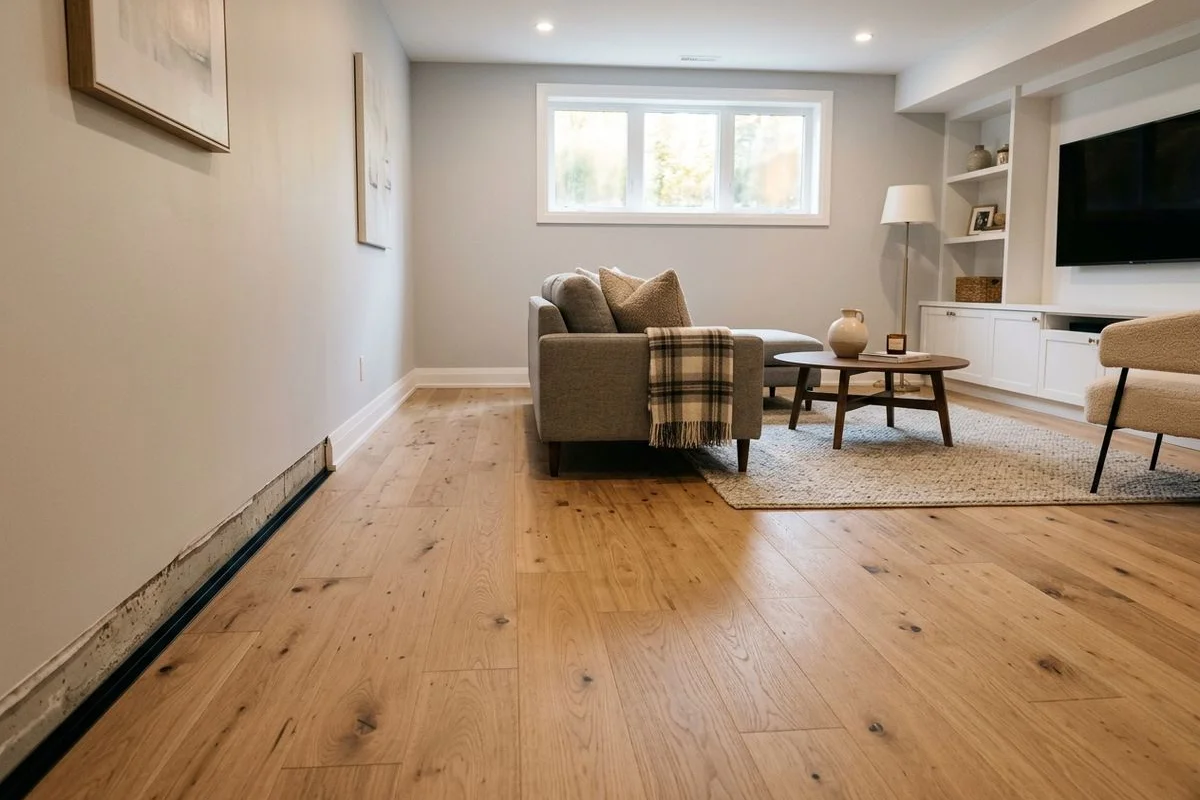
Why solid hardwood fails in Toronto basements
Solid hardwood is hygroscopic - it absorbs and releases moisture from the surrounding air continuously. Toronto basements in winter run 15-30% relative humidity as heating systems dry the air. In summer, without mechanical dehumidification, basement RH climbs to 65-85%. That 50-point seasonal swing is the fundamental problem. Solid hardwood boards gain moisture in summer and swell against each other. They lose moisture in winter and shrink away from each other. The 3/4” thickness amplifies every percentage point of change. After two or three seasonal cycles, boards cup, joint gaps open in winter, and finishes crack along the seams.
Every major hardwood flooring manufacturer voids warranties for below-grade solid hardwood installations. The National Wood Flooring Association (NWFA) guidelines specifically exclude solid hardwood from slab installations. This is not a conservative guideline - it reflects a straightforward material compatibility issue.
For any Toronto basement - North York, Etobicoke, Mississauga, Don Mills, Humber Bay - the choice is between engineered hardwood, LVP (luxury vinyl plank), or high-AC laminate. Solid hardwood is not one of the options.
Why engineered hardwood works below grade
The cross-ply plywood core of engineered hardwood resists movement in all directions. Where a solid board swells across its full 3/4” thickness, an engineered board with the same wear-layer species moves 60-70% less in response to the same humidity change. The wear layer - 4-6mm European White Oak, for example - provides the real wood look, feel, and refinishability. The plywood core underneath handles the moisture environment that would destroy a solid board.
The NWFA approves two installation methods for engineered hardwood over concrete slab below grade:
- Glue-down with moisture-barrier adhesive (Bona R848): the adhesive bond provides the vapour barrier and holds the boards flat against the slab
- Floating over a vapour barrier underlayment: 6-mil poly sheeting with overlapped and taped seams, topped by an acoustic foam or cork underlayment
Both methods are NWFA-approved for below-grade engineered hardwood installations. See our guide on glue-down vs floating engineered wood installation for the full comparison of the two methods.
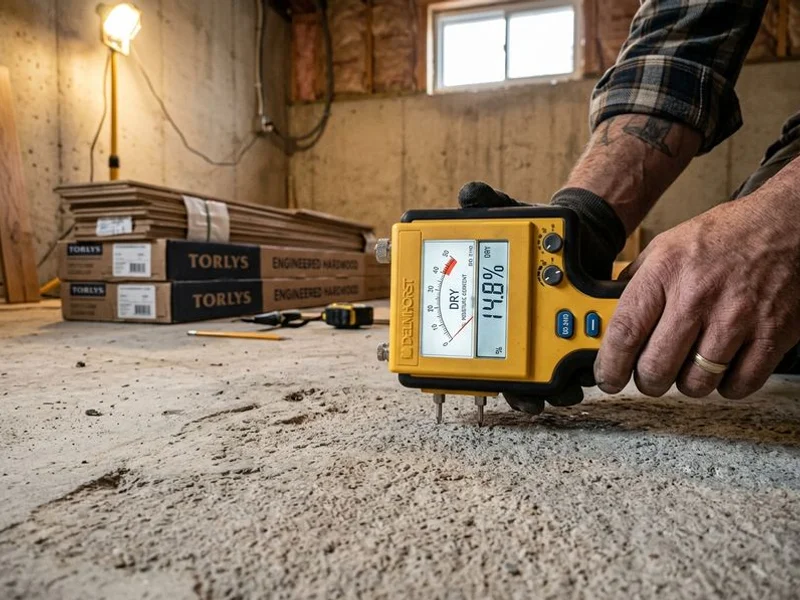
ASTM F2170 moisture testing - the step that cannot be skipped
Before any engineered hardwood installation over a concrete basement slab, an ASTM F2170 in-situ relative humidity probe test is required. The process:
- Drill a 40mm hole into the concrete slab
- Install a calibrated RH sensor into the hole
- Wait 24-72 hours for the hole temperature to stabilise (drilling generates friction heat that gives falsely high readings if read immediately)
- Read the internal slab RH
Engineered hardwood requires a slab RH reading under 75%. The decision tree based on results:
- Under 75% RH: proceed with glue-down (Bona R848) or floating over 6-mil poly vapour barrier
- 75-85% RH: apply a vapour barrier primer (Bona DS 250 or equivalent) before adhesive; re-test after primer cures
- Over 85% RH: the slab is too wet for engineered hardwood. LVP (SPC rigid core) is the correct product choice at this moisture level
A dehumidifier running year-round in a properly waterproofed Toronto basement should hold slab RH in the 45-65% range - well within the acceptable range for engineered hardwood.
Vapour barriers: what works for each install method
For floating installations: 6-mil polyethylene sheeting is the minimum. Seams must be overlapped 6” and taped with moisture-barrier tape. The poly sheet runs up the wall 2-3” before the baseboard covers it. Do not skip the tape on seams - untaped seams allow moisture to migrate laterally between the poly and the board.
For glue-down installations: the vapour barrier is integrated into the adhesive itself when using Bona R848 (moisture-barrier rated). No separate poly layer is required under a full-trowel R848 application. If the slab RH test shows 75-85% RH, a separate primer coat (Bona DS 250) is applied and cured before the adhesive goes down.
Wear layer thickness for basement applications
The wear layer thickness determines how many times the floor can be refinished over its life. In a basement that will be kept long-term, this matters:
- 2mm wear layer: 0-1 refinishes. Most budget engineered sold at home centres is 2mm. For a basement you plan to keep for 20+ years, this is inadequate.
- 3mm wear layer: 1-2 refinishes. A reasonable middle option for a finished basement with light to moderate traffic.
- 4-6mm wear layer: 2-4 refinishes. The same refinish cycle potential as solid hardwood. For Don Mills or North York basements being converted to long-term living space, a 4-6mm wear layer in European White Oak is the correct specification.
The price jump from 2mm to 4mm wear layer runs $2-4/sq ft in material cost. A professional refinish in Toronto costs $5-8/sq ft. A floor that can be refinished twice instead of zero times saves the cost of a complete reinstall over a 25-year horizon.
Engineered hardwood vs LVP for Toronto basements
| Product | Below-grade rated | Slab RH max | Cost installed | Refinishable | Thermal comfort |
|---|---|---|---|---|---|
| Engineered hardwood (4-6mm) | Yes | 75% (or 85% with primer) | $8-14/sq ft | Yes (2-4 times) | Warm - real wood underfoot |
| Engineered hardwood (2-3mm) | Yes | 75% | $6-10/sq ft | Limited (0-2 times) | Warm |
| LVP / SPC rigid core (COREtec) | Yes | 100% waterproof | $4-8/sq ft | No | Harder and cooler underfoot |
The decision between engineered hardwood and LVP comes down to slab RH and long-term goals. If ASTM F2170 confirms slab RH under 75% and the basement is being converted to proper finished living space that you plan to keep long-term, engineered hardwood with a 4-6mm wear layer gives better thermal comfort underfoot and the ability to refinish the floor rather than replace it when it shows wear. If there is any active moisture concern, the slab RH is above 75%, or the space sees regular water exposure (utility room, laundry adjacent), LVP (SPC rigid core like COREtec) is the correct product - it is 100% waterproof and carries no moisture risk.
What proper dehumidification looks like
A Toronto basement with engineered hardwood installed should run a dehumidifier year-round. A properly waterproofed basement running a 50-pint dehumidifier maintains 45-55% RH through the summer months - within the NWFA-recommended 35-55% range for wood flooring. Without mechanical dehumidification, summer basement RH in the Greater Toronto Area regularly reaches 70-80%, which strains any wood floor and can cause cupping even in properly installed engineered boards.
Dehumidification is not optional after engineered hardwood installation in a Toronto basement - it is part of the maintenance requirement.
Toronto Quality Wood Flooring provides free in-home estimates for all basement flooring projects. Our quote includes ASTM F2170 slab moisture testing and a 48-hour fixed-price written quote covering material, vapour barrier, and installation. Contact us to schedule your assessment before purchasing any flooring material.
ASTM F2170 Testing: Step by Step
The ASTM F2170 in-situ relative humidity test is the industry-standard method for measuring how much moisture is present inside a concrete slab - not just on its surface. A surface pin meter reads the top 5-10mm of concrete; the ASTM F2170 probe reads the moisture condition at 40% depth through the slab, which is where the equilibrium moisture exchange with the floor system actually happens. Surface meter readings can be misleadingly low on a slab that has high internal moisture.
The testing process involves drilling a 40mm diameter hole into the concrete slab to 40% of its total depth - for a 100mm slab, that means drilling to 40mm. A calibrated RH probe (Tramex Encounter Plus, Vaisala HMP series, or similar) is inserted into the hole and the opening is sealed with tape to create a closed cavity. The probe must be left in place for a minimum of 24 hours at standard equilibration; 72 hours is the preferred duration when readings come in above 70% RH, as borderline readings can shift meaningfully over the additional equilibration time. Reading a freshly drilled hole produces falsely elevated numbers because the drilling generates friction heat - allowing the hole to reach ambient temperature before reading is critical for accurate results.
The in-situ RH reading determines the next step. Under 75% RH means engineered hardwood can proceed using standard installation methods - either glue-down with Bona R848 or floating over 6-mil poly vapour barrier. Between 75% and 85% RH, engineered hardwood is still viable but requires a vapour barrier primer applied first: Bona DS 250 or equivalent sealer is applied to the slab surface, allowed to cure per the manufacturer’s schedule (typically 4-8 hours), and then the adhesive layer is applied over it. Above 85% RH, the slab moisture level is too high for engineered hardwood under any major manufacturer’s warranty. At that moisture level, LVP with SPC (rigid stone polymer composite) core is the correct product - it is 100% waterproof and unaffected by slab moisture at any level.
When readings are borderline - in the 72-78% range - two options exist. The first is to wait for the drier winter months and re-test: Toronto slabs in late January and February frequently read 5-8 points lower than the same slab in August, because the outside air driving moisture into the building is much drier in winter. The second is to install a dehumidifier in the basement, run it for 30 days at 35-45% target RH, and re-test. A well-waterproofed slab in a properly dehumidified basement will often drop to within the engineered hardwood threshold after a 30-day conditioning period.
Engineered Hardwood vs LVP: When Each Wins in Toronto Basements
The choice between engineered hardwood and LVP in a Toronto basement is not primarily a preference question - it is a function of what the ASTM F2170 test reveals and how the basement is used. Both products are legitimate; they serve different conditions.
Engineered hardwood wins when the slab RH comes in under 70% with a margin of comfort, the budget allows for real wood (the resale value and visual warmth are real and measurable advantages), the homeowner wants the ability to refinish the floor rather than replace it at the end of the floor’s surface life, and the basement is being converted to a primary living space - a home office, a family room, a recreation room or den where the floor will be seen and walked on constantly. In these conditions, a 4-6mm European White Oak engineered floor on a properly tested basement slab performs for decades and gives the homeowner refinish options that LVP simply does not offer.
LVP with SPC core wins when the slab RH is in the 75-85% range, when there is any history of water intrusion in the basement (even a single flooding event in the previous decade), when the basement is adjacent to a laundry room or utility room with active plumbing, or when the primary goal is cost containment in a rental unit. SPC LVP costs $4-8/sq ft installed versus $8-14/sq ft for quality engineered hardwood, and it carries zero moisture risk. It cannot be refinished, but it is straightforward to replace individual planks if a section is damaged.
Both products are valid choices when the slab RH falls in the 65-75% zone. The decision in that range comes down to the homeowner’s risk tolerance, their long-term plan for the space, and their budget. A homeowner who wants real wood and has the budget for it can proceed confidently at 68% RH with a 4-6mm engineered product and proper adhesive. A homeowner who is converting a previously wet basement and wants zero ongoing concern about the floor is better served by LVP regardless of how good the current test result looks.
Real Project Example: North York Basement
A typical North York split-level from the early 1970s has an unfinished concrete slab-on-grade basement that the owners want to convert to a home office and family room. The slab is in good structural condition with no visible cracks, and the exterior waterproofing was updated approximately eight years prior. A 50-pint dehumidifier has been running in the space for the past two years. The homeowner’s goal is real hardwood flooring - not LVP - and they want to refinish the floor once in the future.
ASTM F2170 testing on that slab produces a reading of 68% RH, well within the acceptable range for engineered hardwood. The specification chosen is 5mm European White Oak engineered with a 4mm wear layer (enough for two future refinishes), installed glue-down using Bona R848 moisture-barrier adhesive. Subfloor prep involves grinding two low spots and applying self-levelling compound before the adhesive goes down. The finished result is a warm, real-wood basement floor that reads as premium finished living space rather than a converted utility area. The dehumidifier continues running year-round to maintain basement RH between 40-55%, which keeps the slab reading stable season to season.
Free In-Home Assessment
Toronto Quality Wood Flooring provides a free in-home assessment for all basement flooring projects. We visit the site, conduct ASTM F2170 moisture testing on the slab, assess the subfloor condition, and deliver a 48-hour fixed-price written quote covering material, vapour barrier, and installation. Contact us before purchasing any material - the moisture test result determines the product, and the product determines everything else.