The choice is a structural question, not a quality ranking
Engineered vs solid hardwood flooring is not a debate about which product is better. It is a question of which product the structure of your home permits. Your subfloor material and floor level answer the question before you look at a single sample board.
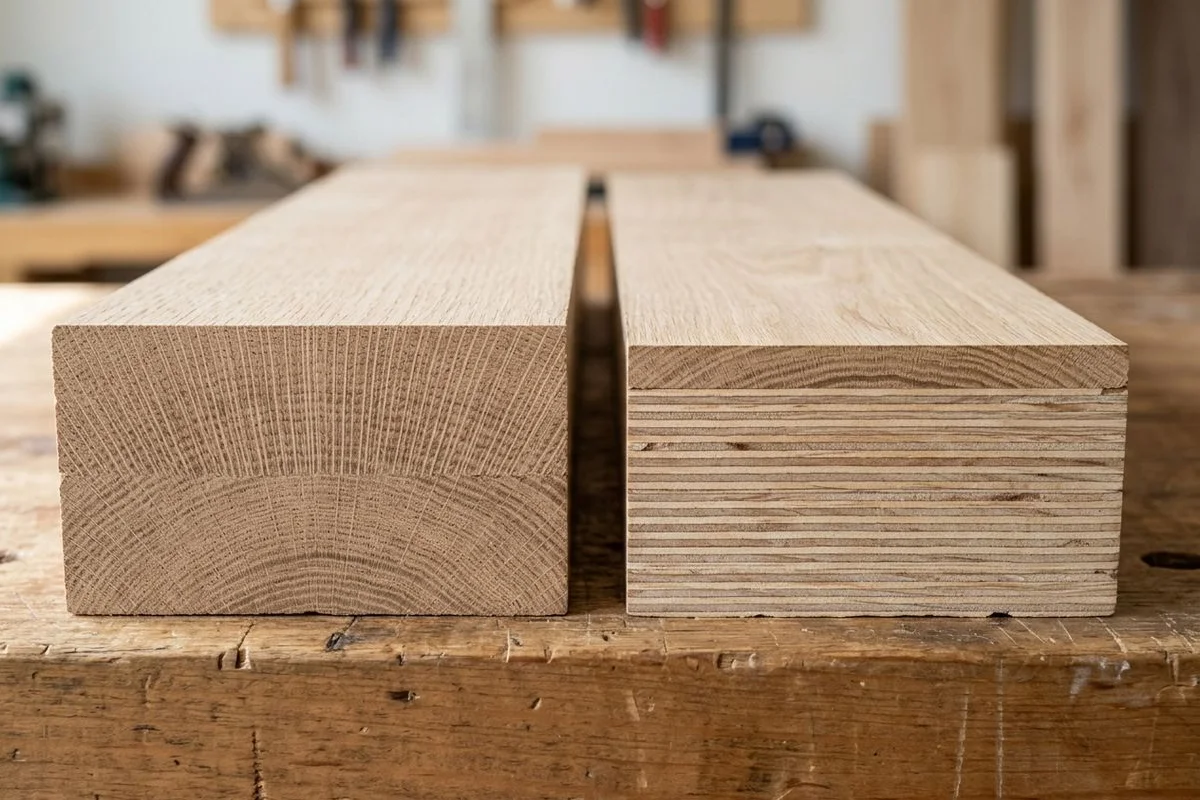
Solid hardwood is a single piece of wood milled top to bottom - 3/4” thick in the standard residential format, with 6mm or more of usable wear layer above the tongue. That construction gives you four to six refinish cycles over the floor’s lifetime. It also means the board moves with every shift in ambient humidity. Solid hardwood gains and loses moisture continuously, which is manageable on a plywood subfloor over joists where the wood can flex slightly without consequence. On a concrete slab, that same movement has nowhere to go - which is why no major manufacturer rates solid hardwood for slab installation. The National Wood Flooring Association (NWFA) guidelines specifically exclude solid hardwood from below-grade and slab installations.
Engineered hardwood is a 2-6mm real wood veneer - European White Oak, Red Oak, Hickory, Walnut - bonded over a 5-9 ply plywood core. The cross-ply construction resists expansion and contraction in all directions, which is what makes it suitable for concrete slabs, below-grade rooms, and radiant heat systems.
Where solid hardwood wins
Solid hardwood is the right product in these specific situations:
- Plywood subfloor above grade - main floor or second floor over joists: solid hardwood is the traditional standard and delivers the most refinish cycles per dollar on Red Oak ($4-7/sq ft material) or White Oak ($7-12/sq ft material)
- Maximum refinish cycles: a 3/4” solid board can be sanded 4-6 times over its life, removing roughly 1-1.5mm per sand. This is the correct product for a home where you want to change stain colour every 15-20 years
- Heritage restoration in Cabbagetown, the Annex, Leslieville: original pre-1940 floors are solid hardwood. Matching them for a proper restoration requires solid boards of the same species and width
- Radiant heat at controlled low temperatures (under 80°F / 27°C consistent): solid hardwood can work with radiant heat when temperatures are kept stable and the product is acclimatised properly - though engineered tolerates temperature fluctuations better
What solid hardwood cannot do: it cannot go over a concrete slab, it cannot go below grade, and it cannot match the dimensional stability of engineered on wide planks (over 5”) where seasonal movement is most visible.
Where engineered hardwood wins
Engineered hardwood solves the structural problems that solid cannot:
- Concrete slab at any grade level: engineered is the only hardwood-look product rated for slab installation. Mississauga and Etobicoke slab-on-grade new builds, Humber Bay condos, and Don Mills basement conversions all require engineered
- Below-grade installations: the cross-ply core resists moisture-driven expansion that would destroy solid boards in a Toronto basement (see our engineered wood flooring hub for installation details)
- Radiant heat with temperature variation: engineered handles the heating cycles without the gap-and-cup cycle that solid produces at the same conditions
- Condo buildings with IIC acoustic requirements: floating engineered over an acoustic underlayment rated IIC 55-67 is the standard method for Yorkville, downtown core, and Humber Bay buildings where condo boards require sound testing documentation
- Pre-finished installation: engineered pre-finished boards are walkable the same day. No on-site finishing, no cure time, no occupants displaced for days
The wear layer question
Wear layer thickness determines refinish potential - and this is where budget engineered from home centres falls short:
- 2mm wear layer: 0-1 refinishes. Most mass-market engineered sold at big-box stores is 2mm. It cannot be meaningfully refinished.
- 3mm wear layer: 1-2 refinishes
- 4-6mm wear layer: 2-4 refinishes - comparable to solid hardwood on a per-decade basis
If you are buying engineered hardwood expecting to refinish it multiple times, confirm the wear layer measurement above the tongue, not the total board thickness.
Side-by-side comparison
| Attribute | 3/4” Solid Hardwood | 2mm Engineered | 4-6mm Engineered |
|---|---|---|---|
| Subfloor | Plywood only | Concrete or plywood | Concrete or plywood |
| Below grade | No | Yes | Yes |
| Radiant heat | Low-temp only | Yes | Yes |
| Refinish cycles | 4-6 | 0-1 | 2-4 |
| Pre-finished option | No | Yes | Yes |
| Material cost | $4-8/sq ft | $5-10/sq ft | $10-18/sq ft |
| Installation cost | $4-8/sq ft (nail-down) | $5-10/sq ft (glue-down) | $5-10/sq ft (glue-down) |
Price reality for Toronto projects
Solid 3/4” Red Oak material runs $4-7/sq ft. Installation by nail-down adds $4-8/sq ft, bringing fully installed Red Oak to roughly $8-15/sq ft. Engineered 3mm White Oak material runs $6-10/sq ft. Engineered 6mm White Oak - the product we most often specify for Etobicoke and North York main floors - runs $10-16/sq ft. Glue-down installation over concrete adds $5-10/sq ft for engineered.
Premium engineered White Oak with a 6mm wear layer installed in a North York living room will cost more than mid-grade solid Red Oak in the same room. The two products are not interchangeable on price any more than they are on performance.
Concrete slab prep adds cost that wood-over-joist does not: self-levelling compound ($2-5/sq ft), ASTM F2170 moisture testing (included in our quotes), and moisture-barrier adhesive. Budget for the full scope before comparing material prices alone.
How to decide for your home
Answer these three questions in order:
- What is your subfloor? If concrete slab: engineered only. If plywood over joists: either product works.
- What floor level? Below grade: engineered only. Above grade: either.
- Do you have radiant heat? If yes and temperatures vary more than 10°F seasonally: engineered is the safer choice.
If all three answers point to either product being viable, the decision comes down to refinish-cycle priorities and budget. For a heritage home in Leslieville where the original floors are solid Red Oak, match solid. For a new Humber Bay condo over concrete, engineered 4mm European White Oak is the correct product regardless of budget.
Toronto Quality Wood Flooring provides free in-home estimates for all flooring projects, including a written 48-hour fixed-price quote covering material, subfloor prep, and installation. Contact us to assess your subfloor and room conditions before you purchase any material.
Engineered Hardwood by Application: GTA Scenarios
The choice between engineered and solid hardwood is not just a general structural question - it plays out differently depending on the specific neighbourhood and era of home you are dealing with. The GTA spans a wide range of construction types, from postwar slab-on-grade bungalows to Victorian row houses to condo towers, and each demands a different approach.
Scarborough and North York Slab-on-Grade Builds (Post-1960)
Many North York postwar bungalows and Scarborough semi-detached homes built between 1955 and 1980 have concrete slab subfloors throughout the main level. This was a common construction method for affordable residential builds in the era and it fundamentally determines what flooring products are viable today. Solid hardwood is not rated for slab installation under any major manufacturer’s warranty - the moisture from the concrete, combined with the seasonal humidity swings Toronto experiences, will cause solid boards to cup and fail within a few years. Engineered glue-down is the only hardwood option for these homes.
The typical specification for a Scarborough or North York slab install is a 4-6mm European White Oak wear layer, installed with Bona R848 moisture-barrier adhesive applied with a 1/4” V-notch trowel. Before any material is ordered, an ASTM F2170 in-situ relative humidity test is conducted - drilling a 40mm hole into the slab and reading internal RH after 24-72 hours of equilibration. The reading must come in below 75% RH for engineered hardwood to proceed. If the reading is in the 75-85% range, a vapour barrier primer (Bona DS 250) is required before the adhesive layer.
Rosedale and Forest Hill Above-Grade Pre-1940 Homes
Rosedale and Forest Hill homes built before 1940 typically have original plywood or solid plank subfloors over dimensional lumber joists - the ideal substrate for nail-down solid hardwood. These homes benefit most from solid hardwood installation. The original floors in many of these properties are solid Red Pine or Red Oak strip, and matching those materials in a proper restoration or addition project requires solid boards of the same species and width. Engineered hardwood works fine on these subfloors as well, but solid hardwood preserves heritage authenticity in these homes and provides four to six refinish cycles over the floor’s lifetime - enough to last another generation.
The refinish potential matters in these homes. A solid 3/4” Red Oak board in a Rosedale home installed in 1990 may still have two or three refinishes remaining. An engineered overlay installed over an existing subfloor would only make sense if the original plank subfloor were too uneven to accept nail-down, or if a specific wide-plank width in a particular species were not available in solid form.
Humber Bay and Yorkville Condos
Condo installations in Humber Bay, Yorkville, and the downtown core have an additional requirement that detached home projects do not face: the building’s IIC (Impact Insulation Class) acoustic threshold. Most Toronto condo boards require IIC 55+ floor impact noise ratings before approving any flooring installation. This is enforced to protect residents in units below from footstep noise transmission.
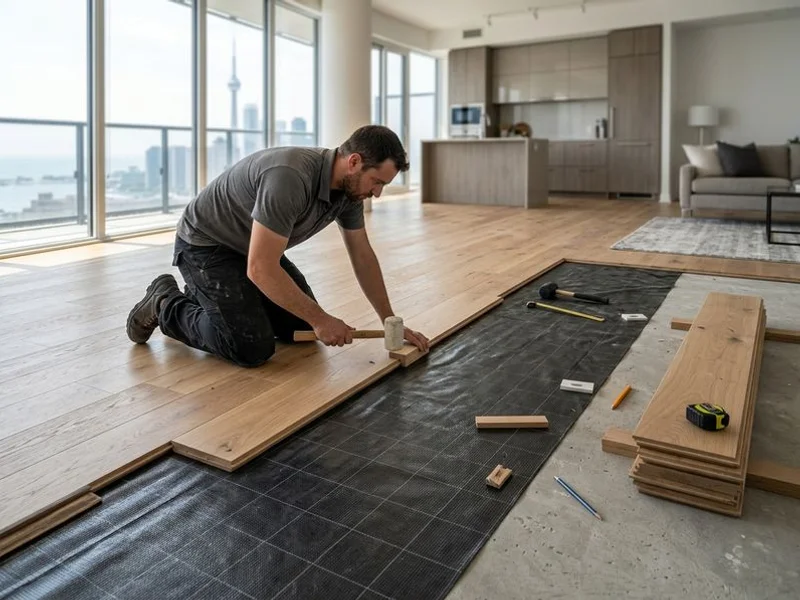
Engineered hardwood floating over a certified acoustic underlayment is the standard solution. A basic foam underlayment does not pass - typical foam provides IIC 42-48, which falls short of the 55+ requirement. Cork underlayment at 6mm thickness achieves IIC 52-58; Acoustiblok rubber membrane achieves IIC 58-65. Before beginning any condo installation, the underlayment’s IIC certification document must be provided to the condo board or property manager for approval. Condo boards typically prohibit direct nail-down into concrete and require the IIC-certified floating system to be specified in advance. Glue-down with Bona R848 is a viable alternative for condo installations where the property manager approves it - the adhesive bond eliminates the air gap that causes hollow-underfoot sound in floating installs.
Below-Grade Finished Basements (Etobicoke and Mississauga)
Solid hardwood is not suitable for any below-grade installation, and this applies to Etobicoke and Mississauga finished basements just as it does to Toronto proper. The concrete slab in a below-grade room maintains higher moisture levels year-round than a slab at grade, and the seasonal RH swings in a Toronto basement are extreme enough to destroy solid hardwood within a few years.
Engineered hardwood is the correct choice when the slab passes ASTM F2170 testing below 75% RH. A 4-6mm wear layer in European White Oak or Walnut provides the real wood look and feel that differentiates a finished basement from a utility space. When RH readings come in above 75%, and especially when there is any history of water intrusion in the basement, LVP with an SPC rigid core is the safer product - it is 100% waterproof and carries no moisture risk. The engineered vs LVP decision in below-grade spaces is ultimately a question of what the ASTM F2170 reading tells you.
How to Choose: 4 Questions to Ask
Before selecting engineered or solid hardwood, work through these four questions in order. The answers direct you to the correct product without requiring a flooring background to interpret:
- What is my subfloor? Concrete slab: engineered only. Plywood over joists: either product is viable - continue to the next question.
- Is the installation above grade, at grade, or below grade? Below grade: engineered only. At grade on concrete: engineered only. Above grade on plywood: either product works - continue.
- Do I have or plan to install radiant in-floor heat? Radiant heat with temperature fluctuations of more than 10°F seasonally: engineered is the significantly safer choice. Radiant heat at consistently low temperatures (under 80°F / 27°C with stable operation): solid hardwood can work with proper acclimatisation, though engineered still tolerates temperature variation better.
- How many refinish cycles do I expect over the life of the home? If you want three or more refinishes over the next 30-40 years, a 3/4” solid hardwood board delivers that refinish depth at the best cost per cycle. If you want one or two refinishes and prioritise dimensional stability, a 4-6mm engineered board gives comparable refinish potential with better resistance to seasonal movement.
If the first two questions point to engineered, the remaining questions are about which grade of engineered to specify - not about the product type. If all four questions leave you with a choice, the deciding factor is almost always refinish-cycle priority versus budget.
Free In-Home Assessment
Toronto Quality Wood Flooring offers a free in-home assessment for every project. We visit the site, identify your subfloor type, test concrete moisture where applicable, and provide a 48-hour fixed-price written quote covering material, subfloor prep, and installation. There is no obligation after the assessment. Contact us to book your visit anywhere in the Greater Toronto Area.