Cupping and crowning: what each looks like and what causes them
Cupping and crowning are moisture deformation - the boards have changed shape because moisture moved unevenly through the wood. They are not material defects. The floor is responding correctly to a moisture imbalance. Understanding which deformation you have tells you where the moisture is coming from.
See the hardwood floor repairs hub for a full overview of repair services.
Cupping
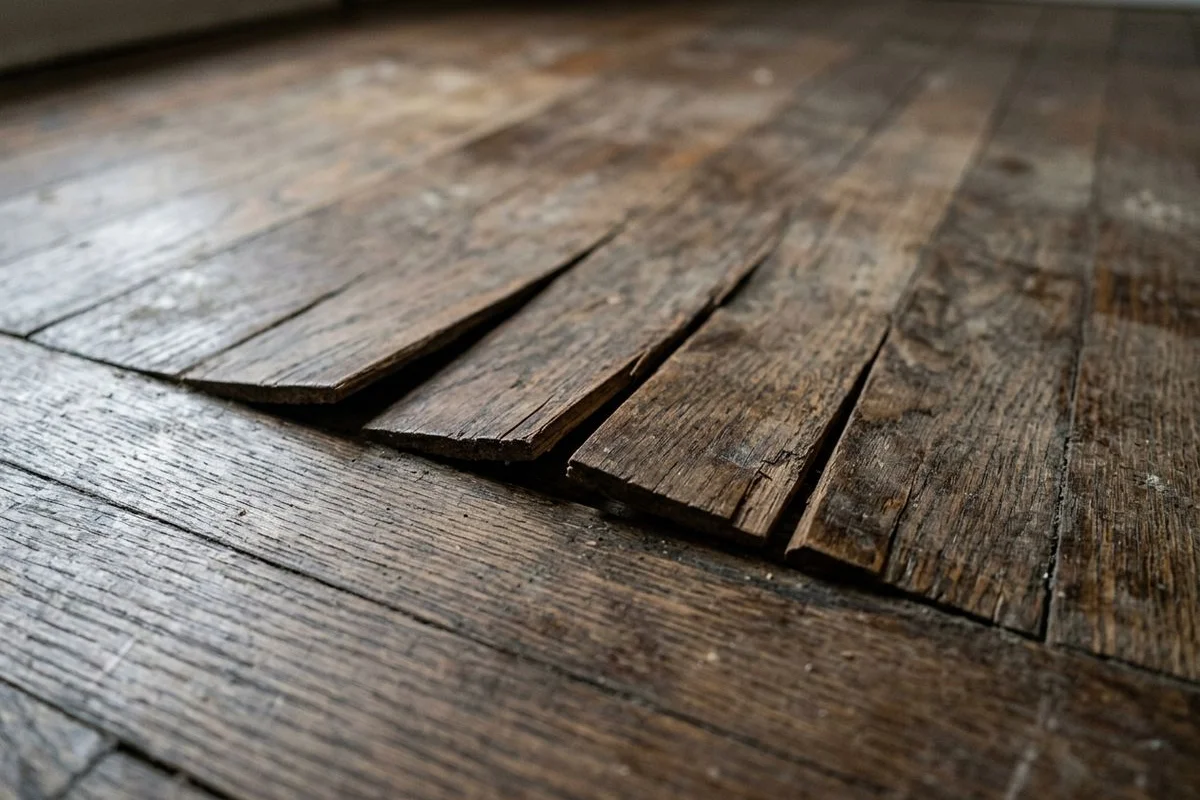
Cupping: the edges of each board are higher than the centre. Lay a metal straightedge (6” or 12”) across the board width - if there is a gap at the centre and contact at the edges, the board is cupped. The boards look like shallow troughs or channels running their length.
Cause: moisture from below is entering the underside of the board faster than the face can absorb it. The underside swells more than the face, pushing the edges upward. Common sources in Toronto homes:
- Slab moisture (basements or slab-on-grade in Etobicoke and Mississauga new builds) where the concrete RH is too high for the floor system above it
- Below-grade humidity reaching the joist cavity in North York and Don Mills homes without adequate basement dehumidification - Toronto summer RH regularly reaches 70-80% in uncontrolled basements
- Concealed plumbing leak - localised cupping concentrated near a wall, dishwasher, or bathroom is often a leak rather than ambient humidity
- Boards installed before full acclimation on a slab that had not fully cured
Diagnostic: cupping under 2mm (gap at centre of a 12” straightedge is under 2mm) may flatten naturally if the moisture source is corrected. Cupping over 3mm is unlikely to self-correct fully. Cupping over 4mm that has persisted for more than one season has often permanently set the wood fibres.
Crowning
Crowning: the centre of each board is higher than the edges. The boards look like a slight arch or hump. The same straightedge test: contact at centre, gap at edges.
The most common cause of crowning in Toronto homes is sanding too soon after a cupping event. When a floor cups (edges high, centre low) and someone sands it while it is still cupped - making it flat - then the moisture source is corrected and the floor dries out, the edges contract below the now-lowered centre. The result is crowning: centre high, edges low. This is a direct consequence of sanding a cupped floor before the moisture problem was resolved.
Surface wetting also causes crowning: a spill, aggressive wet mopping, or high surface humidity causes the face of the board to absorb moisture faster than the back, pushing the centre up temporarily.
Diagnosis quick reference
| Condition | Likely cause | Urgency | Fix approach | Boards need replacing? |
|---|---|---|---|---|
| Cupping under 2mm | Seasonal humidity, minor source | Low | Fix moisture source, wait 30-60 days, re-assess | Usually no |
| Cupping 2-3mm | Active moisture source (leak or humidity) | Medium | Fix source, wait 60 days, re-test, then sand if boards have returned | Possibly the worst boards |
| Cupping over 4mm (persistent) | Significant moisture problem, possibly long-term | High | Fix source, wait, test wood MC - boards may have permanently set | Likely yes for worst boards |
| Crowning (post-sanding) | Floor was sanded while still cupped | Medium-low | Stabilise humidity, wait for equilibrium, re-sand when boards are flat | No |
| Crowning (surface wetting) | Spill or wet mopping | Low | Dry thoroughly, assess - most surface-wetting crowning resolves | No (unless severe and prolonged) |
The correct repair sequence for cupping
The order of operations is non-negotiable. Sanding a cupped floor before the moisture source is corrected produces a flat floor that re-cups within the next season as the moisture continues. The NWFA guidelines are clear on this: environmental conditions must be corrected before any sanding is performed.
Step 1 - Identify and eliminate the moisture source
This sometimes requires another trade first. Localised cupping near a dishwasher, sink, or exterior wall: call a plumber or check the window seals before touching the floor. Widespread cupping in a basement or ground floor: test slab RH with an ASTM F2170 probe and assess whether the dehumidification system is adequate. In a Toronto basement without a dehumidifier running through summer, slab and ambient RH routinely exceed the threshold for wood flooring.
Step 2 - Allow the floor to return to target moisture content
Once the moisture source is corrected, the floor needs time to release absorbed moisture and return to the equilibrium moisture content for Toronto interiors (typically 7-9% wood MC at 35-50% RH). This takes 2-8 weeks depending on severity. Running a dehumidifier in the space accelerates the process.
Step 3 - Measure before sanding
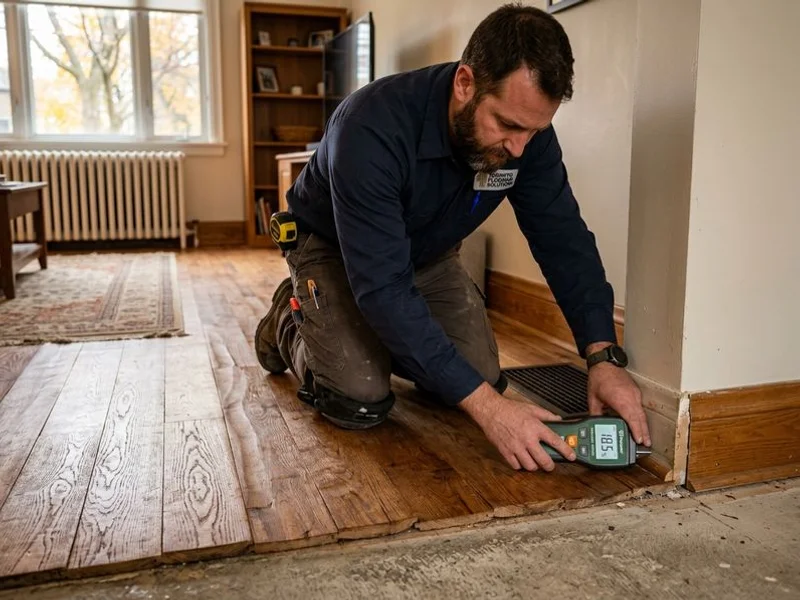
Use a calibrated pin-type moisture meter to confirm the wood has returned to acceptable moisture content. The subfloor MC and the hardwood MC should be within 2% of each other. Do not sand until these readings confirm equilibrium.
Step 4 - Assess whether boards will flatten
If cupping was under 3mm and the moisture source has been corrected, most boards will have returned close to flat after the drying period. Re-check with the straightedge. If boards are within 1-2mm of flat, a standard sand will bring them true.
If cupping was over 4mm and the boards have held that shape through one or more seasons, the wood fibres may have permanently deformed. These boards will not flatten with humidity correction alone. The straightedge test after drying tells you which boards need to be replaced before the sand begins.
Step 5 - Sand flat and refinish
Once moisture readings confirm equilibrium and boards are assessed, the floor can be sanded flat using standard refinishing technique. Finish with Bona Traffic HD for maximum hardness in high-traffic areas, or Rubio Monocoat for a hardwax oil finish if the original floor used that system. Both products are appropriate for Toronto residential hardwood.
The crowning fix
If crowning followed a premature sand (the floor was sanded while cupped, then dried and crowned): stabilise the room humidity at 35-50% RH, give the floor 4-6 weeks to reach equilibrium, then re-sand. The boards should return to flat once they are at stable moisture content.
If crowning followed surface wetting: dry the area thoroughly with fans and dehumidification. Most surface-wetting crowning resolves on its own within 2-4 weeks if the source is stopped. Assess the boards again at that point before deciding whether sanding is needed.
What sanding cannot fix
Two situations exist where sanding is not the answer:
- Boards that have permanently set from prolonged severe cupping (over 4mm, multiple seasons) - these need replacement before the sand
- A moisture source that is still active - sanding produces a flat floor that immediately begins re-cupping as moisture continues to enter
Toronto Quality Wood Flooring will not sand a cupped floor without first confirming the moisture source has been corrected. This protects the homeowner from paying for the same repair twice and protects the quality of our work. The free in-home assessment includes subfloor moisture testing and an honest timeline - including whether another trade needs to be called first.
Contact Toronto Quality Wood Flooring for a free in-home moisture diagnostic and a 48-hour fixed-price written quote for the remediation work once conditions are confirmed correct.
Diagnosing the Moisture Source
The single step that most homeowners skip - and that most determines whether a cupping repair holds long-term - is identifying exactly where the moisture is entering the floor system. Sanding a cupped floor without fixing the moisture source produces a flat floor that re-cups within the next season. The floor is not the problem; the floor is reporting a problem from somewhere else. There are four distinct categories of moisture source that produce cupping in Toronto homes, and each has a different fix.
Concrete Slab Vapour Transmission
This is the most common cause of cupping in Etobicoke and Mississauga slab-on-grade homes, and in any Toronto home where engineered hardwood was installed over a concrete slab without adequate vapour barrier testing. Concrete slabs release moisture vapour continuously - the rate depends on the slab age, season, and whether the exterior waterproofing is intact. When that vapour reaches the underside of the floor boards faster than the face can balance, the boards cup.
Diagnosis: conduct an ASTM F2170 in-situ RH probe test on the slab in the affected area. If the reading exceeds 75% RH, slab vapour transmission is the likely culprit. The fix involves addressing the source (waterproofing, dehumidification, or both) before any remediation of the floor itself. A vapour barrier primer applied under the adhesive layer would have prevented this - but it can only be applied before installation, not after.
Below-Grade Exterior Wall Moisture
Cupping concentrated along exterior walls - particularly north-facing walls in Toronto homes - is a specific symptom of inadequate exterior waterproofing or failing parging on the foundation wall. Moisture migrates through the wall, reaching the floor system at the perimeter before spreading inward. The cupping pattern follows the exterior wall rather than the centre of the room.
The floor diagnosis is the straightforward part of this problem. Fixing it requires an exterior waterproofing assessment and, in most cases, work on the wall itself: parging repair, exterior membrane, or drainage improvement. A floor contractor can identify the pattern; resolving the underlying cause may require a waterproofing contractor before the floor work can proceed. Any floor repair attempted while the wall moisture source remains active will fail within one or two seasons.
Plumbing Leak
Cupping concentrated around a specific appliance or fixture - dishwasher, refrigerator water line, bathroom directly above, or washing machine - and nowhere else in the room is the signature of a slow plumbing leak. These leaks often develop over months before the cupping becomes noticeable. By the time the floor deformation is visible, the leak may have been running long enough to saturate the subfloor in that area.
Check under the dishwasher, behind the refrigerator, and along the supply and drain lines for any appliance near the cupped zone. Even a very slow drip - one that would not be noticed day to day - can maintain the subfloor above threshold moisture content indefinitely. Call a plumber to confirm before proceeding with any floor remediation.
HVAC or Seasonal Imbalance
Whole-floor cupping that develops slowly over the winter months, affects the entire room rather than a concentrated area, and corresponds to the heating season is almost always an HVAC or humidity-control issue. In winter, forced-air heating without a humidifier running will drop Toronto interior RH to 15-25% - far below the 35-50% range that hardwood floors require. At that extreme low humidity, boards shrink and pull apart (gaps). When the humidifier is then run aggressively to compensate, or when summer arrives and humidity climbs, the boards absorb moisture faster than they can release it and cup.
Whole-floor cupping that develops in summer without a dehumidifier: house RH is exceeding 65%, the boards are absorbing ambient humidity from above. The fix in both cases is humidity control - a whole-home humidifier calibrated to maintain 35-50% RH in winter, and a dehumidifier or air conditioning keeping summer RH below 55%. Correcting the HVAC imbalance first, then monitoring for 60-90 days, often resolves cupping without any sanding required.
Step-by-Step Fix Protocol
Once the moisture source has been identified and permanently corrected, the floor repair follows a defined sequence. Skipping steps or shortening timelines produces a repair that fails.
-
Identify and permanently fix the moisture source. This is non-negotiable as the first step. Not temporarily controlled - fixed. A plumbing repair is made. The dehumidifier is sized and running. The exterior waterproofing is repaired. The HVAC humidity is calibrated. Until this step is complete, no floor work proceeds.
-
Bring the floor to equilibrium. Maintain 40-50% RH in the space for 60-90 days using the corrected HVAC system plus dehumidifier or humidifier as needed. Run a calibrated hygrometer in the room to confirm the RH is holding in range throughout the period - not just sometimes.
-
Re-measure cupping at 30, 60, and 90 days. Use a metal straightedge across the board width and measure the gap at the board centre. Document the measurement at each interval. You are looking for the trend - boards that were cupping 3mm in week one and are at 1.5mm at day 60 are recovering well. Boards that have not moved between day 30 and day 60 after the moisture source is confirmed fixed may have permanently deformed.
-
If cupping is under 2mm at 90 days: the boards have largely returned to flat. Sand with a drum or orbital sander and refinish with the appropriate finish system. Standard refinishing technique applies.
-
If cupping is 2-4mm at 90 days: assess the wear layer thickness remaining. A board with 4mm or more of wear layer can accept one more sanding pass - sand flat and refinish. A board with under 3mm of wear layer remaining cannot be safely sanded to remove 2-4mm of deformation - replacement of the worst boards is required before the sand.
-
If cupping is over 4mm and has “set”: boards that have held a cupped position through one or more full seasonal cycles have often permanently deformed. The wood fibres compress and set in the cupped shape, and humidity correction alone will not return them to flat. These boards require replacement. Once the worst boards are replaced and the subfloor is at correct moisture content, the remaining floor can be sanded and refinished to a uniform result.
Free In-Home Assessment
Toronto Quality Wood Flooring provides free in-home moisture diagnostics for cupping and crowning assessment. We identify the moisture source, measure deformation severity, and give you an honest prognosis - including whether another trade needs to be involved before floor work can start. A 48-hour fixed-price written quote covers the full remediation scope once the moisture conditions are confirmed correct. Contact us to schedule your assessment anywhere in the Greater Toronto Area.