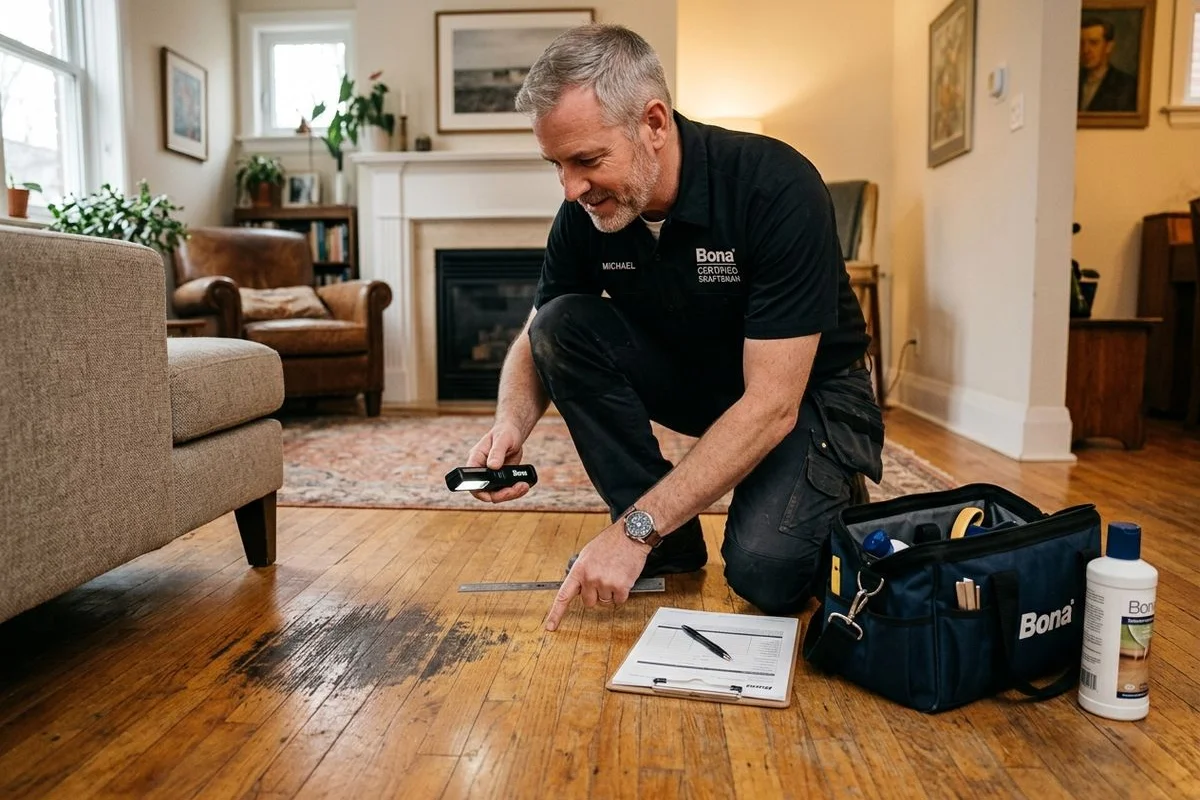
The fundamental question
Can the damage be contained to an area small enough that a spot repair blends invisibly with the surrounding floor? If yes, repair wins on cost and disruption. If the damage is widespread, or if achieving an invisible blend across multiple repair areas would require more labour than a full sand, refinishing the floor is the better long-term investment.
This is not a close call in most cases. The damage pattern on your floor makes one answer clearly correct. The guidance below gives you the framework to read that pattern.
See hardwood floor repairs for the repair service detail. If the floor is showing widespread wear, the guide on signs your hardwood floors need refinishing walks through the indicators that a full refinish is overdue.
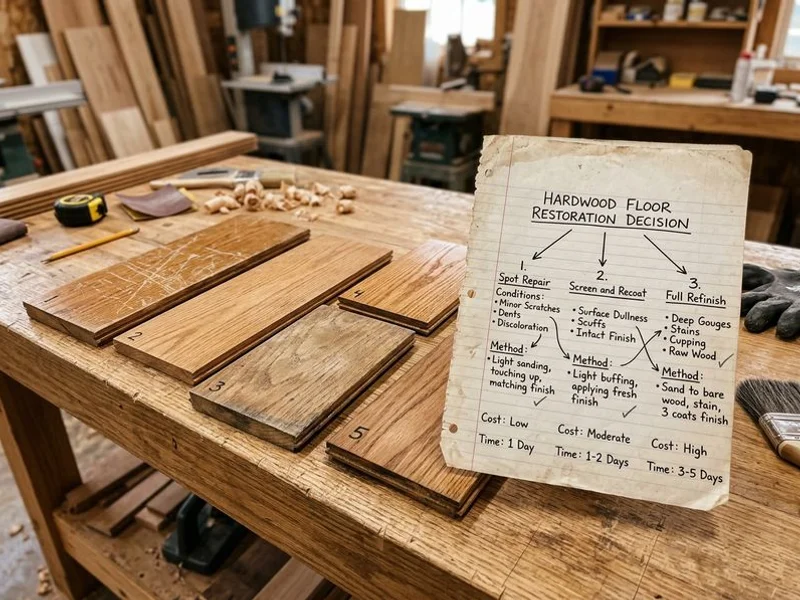
The 20% rule
If more than 20% of the floor surface shows visible damage - scratches, dullness, staining, or wear - a full refinish typically costs less per affected square foot than repairing each damaged section individually. The labour to colour-match and feather-blend ten scattered spot repairs across a room approaches the labour cost of a full sand, without the reset-to-new result that refinishing delivers.
Under 20% of the floor affected with isolated damage: repair wins. Over 20% with damage distributed throughout the room: refinish wins.
When repair is the right answer
Spot repair makes sense when:
- Isolated gouges in otherwise good floor - one or two boards with deep damage, or a few concentrated in a single area (near the dining table, near the door). The surrounding floor is in good condition and the finish is intact. A Dutchman patch or board replacement blends cleanly when the damage is isolated.
- Pet scratches concentrated in one room - claw marks in the living room while the rest of the floor is undamaged. Screen-and-recoat or spot filler repair for the affected zone.
- Single-source water stain from a contained event - a potted plant that overflowed, a dishwasher leak that was caught quickly. The stain is localised and the rest of the floor is unaffected. Spot repair with colour-matched Bona DriFast stain and spot finishing.
- Cupped boards from a fixed moisture source - the dishwasher was replaced, the window seal was repaired. The affected boards are addressed without disturbing the rest of the floor.
- Thin wear layer on engineered floors - if the wear layer is under 2mm, a full sand is not an option. Spot repair or screen-and-recoat is the only viable approach regardless of how widespread the damage is.
Cost for spot repair: $150-450 for a small area. Individual board replacement: $300-800 per board. Dutchman patch: $200-600 per patch. Full refinish of the same room for comparison: $3-8/sq ft over the entire floor.
When full refinish is the right answer
Full sand-and-refinish makes sense when:
- Widespread surface scratches and dullness throughout the traffic pattern - the floor looks worn across the main hall, living room, and dining room. The damage is not isolated; it follows every path people walk. This is the most common refinish trigger for Toronto homes 7-15 years after the last refinish.
- Multiple spot repairs that each need colour matching - trying to blend 8-10 scattered spot repairs across a 600 sq ft room multiplies the colour-match risk. Each patch ages and weathers slightly differently from the surrounding floor. A full sand removes this problem entirely.
- Staining that cannot be removed from the finish surface - deep pet urine staining, dark water rings, or oxidation that has penetrated into the wood. These require sanding to bare wood and re-staining.
- Finish failure - peeling, flaking, or delaminated finish that has lost adhesion to the wood. A screen-and-recoat will not adhere over a failing finish. The floor must be sanded back to bare wood.
- The floor is at refinish age anyway - a floor that is 10-15 years into its current finish cycle and showing general wear is a better candidate for full refinish than for a series of spot repairs that still leave a visually tired floor.
- Colour change desired - spot repairs cannot change the stain colour of the surrounding floor. If the homeowner wants to shift from a dated golden Oak to a cooler grey-brown tone, a full sand is required.
The colour-match challenge of spot repairs
Every spot repair requires matching the stain colour and the sheen level of the existing floor. A well-executed Bona DriFast stain match on fresh wood can be nearly invisible on the day of completion. The challenge is that fresh wood and aged stained wood do not respond identically to the same stain formula, and the new patch may lighten or darken slightly relative to the surrounding floor over the first year as the new finish cures and the wood oxidises.
A single 6” board patch in a 1,000 sq ft North York main floor is invisible with skilled colour matching. Six patches scattered across the same room start to read as a pattern, and the colour drift between old floor and new patches becomes cumulative. The larger the number of spot repairs, the stronger the case for full refinish.
Screen-and-recoat: the middle option
Screen-and-recoat sits between spot repair and full refinish. The process lightly abrades the existing finish surface with a screen pad, then applies one or two fresh coats of finish over the whole room. No sanding to bare wood.
Screen-and-recoat is appropriate when:
- The floor looks dull or flat but has no bare wood showing
- The existing finish has not delaminated or peeled
- There is no wax buildup on the floor (wax prevents new finish adhesion)
- No colour change is needed
Screen-and-recoat does not fix scratches that go through the finish into the wood. It refreshes the sheen and adds a protective layer. Cost: $1-3/sq ft.
Cost comparison
| Option | Typical cost | Timeline | Visual result | Long-term value |
|---|---|---|---|---|
| Spot repair (small area) | $150-450 | 1 day | Excellent if isolated and well colour-matched | Good - extends floor life for the affected area |
| Screen-and-recoat | $1-3/sq ft | 1-2 days | Fresh sheen, no scratch repair | Medium - buys 3-5 years before full refinish |
| Full refinish | $3-8/sq ft | 4-5 days | Reset to like-new | Highest - 7-15 year interval to next refinish |
| Board replacement + spot refinish | $300-800 per board | 2 days | Excellent for isolated structural damage | High when damage is truly isolated |
Decision framework
- Under 5% of floor damaged - repair. The surrounding floor is in good shape and spot work blends well.
- 5-20% of floor damaged - assess the colour-match difficulty and damage distribution. If isolated: repair. If scattered across the room: full refinish is likely more economical.
- Over 20% of floor damaged - refinish. The labour for comprehensive spot repair across that much of the floor approaches the cost of refinishing, without the reset result.
Toronto Quality Wood Flooring provides free in-home assessments to map the damage across your floor and give you an honest recommendation - repair, screen-and-recoat, or full refinish - with a 48-hour fixed-price written quote. Contact us to schedule your assessment anywhere in the Greater Toronto Area including Etobicoke, North York, Mississauga, Don Mills, and Humber Bay.
The Hidden Cost of Waiting
One of the most consistent patterns Toronto Quality Wood Flooring encounters is a floor that was easily repairable six months or a year ago and is now a significantly more expensive project. The repair window for hardwood floor damage is time-sensitive in a way that is not obvious until the damage has progressed.
A small area of bare wood at a doorway threshold - two or three square feet of exposed wood where the finish has worn through from repeated foot traffic - can be addressed with a spot recoat for $150-250. The bare section is cleaned, sealed, and recoated without touching the rest of the floor. Left for twelve months without treatment, that same bare section absorbs moisture and airborne grime into the open grain, causing irreversible greying and grain contamination. The wood fibres in the bare zone oxidise and darken unevenly. By the time the homeowner decides to act, the spot repair option is gone - the discoloured area requires board replacement plus stain matching ($400-700 for that section), and the repaired boards now need a full refinish of the surrounding area to blend the colour match invisibly. A $150 repair window became a $1,500 project because the bare wood was left exposed for a year.
Cupping that appears minor - under 2mm, something you might not even notice if you are not looking for it - can still “set” if the moisture source continues for a full season without being addressed. At 2mm of cup, the floor is not permanently damaged yet; the boards can still return to flat with humidity correction and then be sanded. At the same moisture source left running for another 8-12 months, those same boards can take a permanent set in the cupped position. The wood fibres compress and hold that shape. Humidity correction no longer returns them to flat, and sanding cannot remove the deformation without going through the wear layer. The result is board replacement at $300-800 per board for the worst sections - compared to a free moisture diagnostic and a $0 cost for simply running a dehumidifier 8 months earlier. Early cupping diagnosis is part of the free in-home assessment. Late-stage cupping often means a four-figure remediation project.
The principle extends across every repair category. The $400 repair that gets deferred for a season has a realistic chance of becoming the $4,000 project. The repair window is not permanent.
Neighbourhood-Specific Repair Patterns Toronto Quality Wood Flooring Sees
Different Toronto neighbourhoods and eras of home construction produce distinct patterns of hardwood floor damage. Understanding what is typical for your home type helps set realistic expectations for what the assessment will find.
Cabbagetown and Annex Victorian Row Houses: these narrow-lot homes typically have original narrow Red Pine or Red Oak strip floors that have been through multiple refinishes and possibly multiple DIY recoating attempts over a century of occupancy. The most common repair pattern Toronto Quality Wood Flooring encounters in this housing stock is finish incompatibility - a previous owner applied a retail “restorer” or acrylic topcoat product that left a contaminating layer preventing proper professional finish adhesion. A screen-and-recoat over that layer fails within months. The correct approach is a solvent strip to remove the contaminating layer, followed by a proper bond coat and recoat system. In some cases, the finish layers from different eras have built up to the point where a full sand-to-bare-wood is the cleaner option. These floors rarely need board replacement - the old-growth wood stock used in pre-1940 Toronto construction is exceptionally dense and durable.
North York and Scarborough Postwar Bungalows (1950s-1970s): Red Oak strip floor is the standard in this housing era, and these floors have typically been refinished two or three times since original installation. The most common repair pattern here is discovering that the boards have been sanded down to or near the minimum wear layer remaining - under 2mm in some cases. A homeowner who calls for a standard refinish quote receives unwelcome news: the floor cannot safely accept another full sand without risking the tongue-and-groove joints. For these floors, the options are a very light screen-and-recoat (no drum sander), selective board replacement for the sections with the least wear layer remaining, or acceptance that the floor is at end-of-refinish-life and planning for replacement on a 3-5 year horizon. Spot repairs for localised damage are still viable - the limitation is only on full sand-and-refinish.
Etobicoke and Kingsway Tudor Homes (1930s): quartersawn Oak and old-growth Red Pine floors in these homes are among the most durable original hardwood in the GTA. Quartersawn Oak in particular - milled so the growth rings run perpendicular to the face - is exceptionally resistant to cupping and wear. These floors typically have significant refinish life remaining even after 90 years of use, because the original wood density is far higher than modern kiln-dried lumber. The most common repair pattern in this housing type is localised pet scratches and door-swing wear arcs. These are excellent candidates for spot screen-and-recoat or zone recoat. A full sand-and-refinish in a Kingsway Tudor home is typically a once-in-a-generation decision, not a routine maintenance call.
Mississauga and Oakville New Builds (Post-2000): engineered hardwood, often with a factory-applied finish and a 2mm wear layer, is the standard flooring in this housing era. The most common repair pattern is homeowners discovering that the floor cannot be refinished - the 2mm wear layer factory spec is at or below the minimum threshold for any meaningful sanding. Cosmetic damage in these floors often requires individual plank replacement using the closest available match to the original product (which may have been discontinued), or living with the damage until a full product replacement is planned. This is the repair pattern that most clearly illustrates the difference between 2mm budget engineered and 4-6mm premium engineered - the premium product gives you future options that the budget product does not.
Free In-Home Assessment
Toronto Quality Wood Flooring provides free in-home assessments for every repair and refinish enquiry. We map the damage across the floor, assess wear layer thickness on engineered products, and give you an honest recommendation with a 48-hour fixed-price written quote. Contact us to book your assessment anywhere in the Greater Toronto Area.