Seven signs your hardwood floors need refinishing
Hardwood floors do not fail overnight. The deterioration follows a recognisable sequence from surface dullness through to bare wood exposure - and catching each stage early determines whether you pay $3-5 per sq ft for refinishing or $15-25 per sq ft for full replacement. Toronto Quality Wood Flooring has put together this diagnostic guide to help you place your floor on that spectrum before the window for refinishing closes.
Toronto refinishing averages $3-8 per sq ft in 2026. New installations of comparable solid hardwood run $10-25 per sq ft, before tear-up and disposal. The math for catching issues early is straightforward.
You can review the full technical process on the hardwood floor refinishing service page. The companion guide on refinishing vs replacing hardwood floors covers what to do when the decision is less clear.
The 7-sign diagnostic: urgency and typical costs
The table below gives you a quick reference for all seven signs. The sections that follow break each one down in detail.
| Sign | Urgency Level | Typical Solution | Cost Range |
|---|---|---|---|
| Exposed bare wood | Urgent - act within 6 months | Full sand and refinish | $3-8/sq ft |
| Grey weathering | High - schedule within 3 months | Oxalic acid treatment + full refinish | $4-8/sq ft |
| Deep scratches through finish | Medium-high | Full sand and refinish | $3-8/sq ft |
| Water stains (black) | High - bleaching required | Full refinish + oxalic bleach | $4-8/sq ft |
| General dullness, no bare wood | Low-medium | Screen-and-recoat | $1-3/sq ft |
| Finish flaking or peeling | High - adhesion failure | Sand to bare wood + full refinish | $3-8/sq ft |
| Board separation (gaps over 2mm) | Critical - wear layer check required | Assess wear layer; may require replacement | $3-8/sq ft or $10-25/sq ft |
Sign 1 - Exposed bare wood
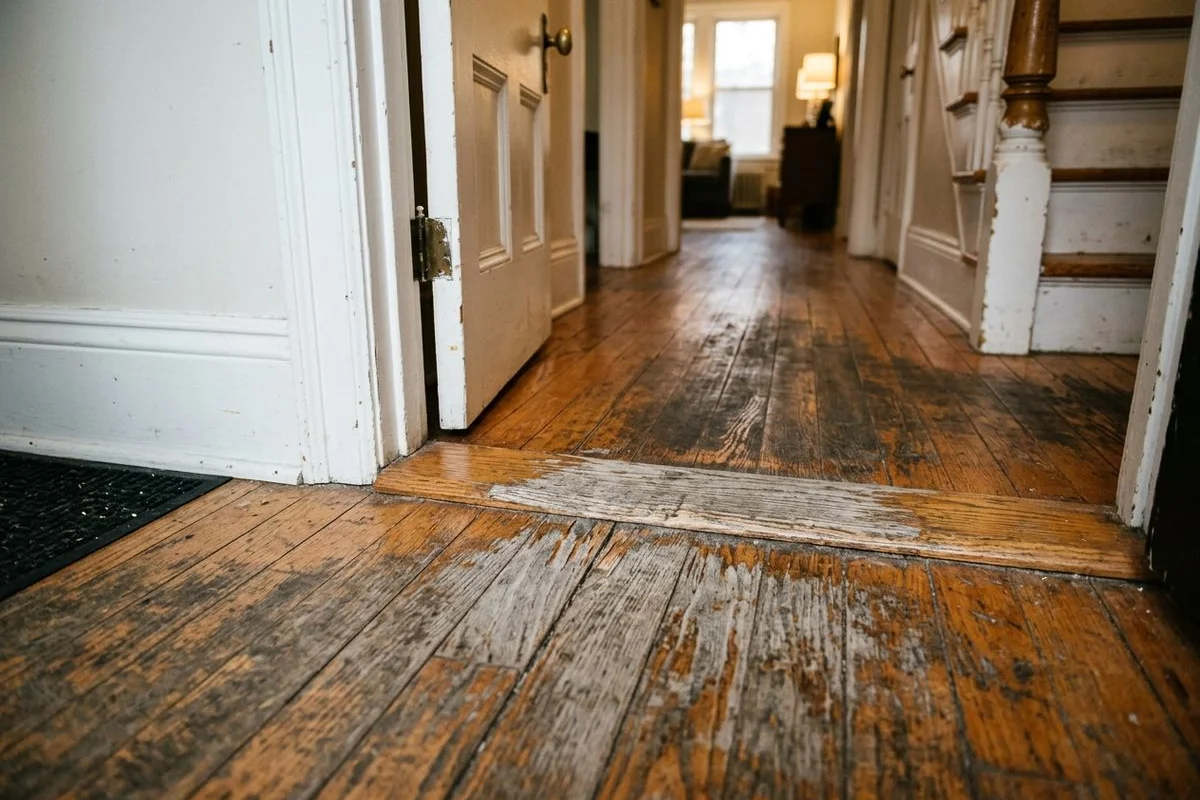
Bare wood at door thresholds and hallway runs is the clearest sign that refinishing can no longer wait. Once the protective finish is gone, every footstep grinds abrasive grit directly into the wood fibres. The wear accelerates quickly from that point.
Use the water drop test to confirm your suspicion. Place a single drop of water on a dull spot and watch for 30 seconds:
- Beading - the water stays rounded on the surface. Your finish is still sealing the wood.
- Absorbing - the droplet flattens, darkens, or soaks in. The seal is broken and bare wood is exposed.
A failed water test at door thresholds in Leaside or Rosedale homes typically means the finish has been gone long enough for visible wear lines to form. Do not delay more than 6-12 months once bare wood shows. Moisture is now wicking directly into the fibres, and the longer it sits, the more it compromises the wood below - turning what would be a straightforward refinish into a repair job.
Bona Traffic HD, a commercial-grade waterborne polyurethane, is the finish Toronto Quality Wood Flooring uses to rebuild that protective layer. Its hardener cross-links the surface at the molecular level, which is why it outlasts standard DIY polyurethane by several years under residential traffic.
Sign 2 - Grey weathering
Greyish, ashen colouring on your hardwood is not simply age - it is UV oxidation and moisture reacting with exposed wood fibres. Indoors, this only happens when the finish has worn completely through. Light surface grey that has not penetrated deeply will sand out during the 36-60-80-100-120 grit sequence without any additional treatment.
Severe grey that persists after the first sanding pass requires oxalic acid treatment before staining. Oxalic acid is a professional-grade wood bleach that reverses the iron oxidation reaction, pulling the grey discolouration out of the fibres. The board is neutralised, dried, and then sanded smooth before the stain goes down.
Deep grey that does not respond to oxalic acid and does not sand out within the available wear layer means the oxidation has penetrated past the point of recovery. Board replacement is the only remaining option at that stage. Toronto Quality Wood Flooring can source heritage-grade Red Oak and Maple to match original floor stock in older homes across Cabbagetown, the Annex, and High Park.
Sign 3 - Deep scratches through the finish
Surface scuffs that stay within the topcoat are a screen-and-recoat candidate. Deep scratches that cut down to bare wood are not - they require full sanding.
The fingernail test gives you an immediate read. Run your fingernail perpendicular across the scratch. If your nail passes over it without catching, the gouge is confined to the finish layer. If your nail catches and drops into the groove, the scratch has broken through to bare wood. At that depth, the scratch is a channel for moisture and fine grit, and it will enlarge every time the floor is walked on.
| Method | What it fixes | Cost (2026) | Wood removed |
|---|---|---|---|
| Screen-and-recoat | Surface scuffs and dullness within the topcoat | $1-3/sq ft | Fraction of the topcoat only |
| Full sand and refinish | Scratches into bare wood, stains, flaking | $3-8/sq ft | Approximately 1mm of wood per sand |
The NWFA (National Wood Flooring Association) recommends measuring the wear layer before any sanding recommendation. Each full sand removes roughly 1mm of wood from the surface. A solid 3/4-inch Red Oak board with 6mm of wear layer above the tongue can typically handle 4-5 refinishes over its lifetime. An engineered board with a 3mm veneer may only tolerate 1-2 passes.
Sign 4 - Water stains
Water staining tells two different stories depending on colour, and the treatment is completely different in each case.
- White stains - milky or cloudy patches that sit on top of or just within the finish layer. These are caused by surface moisture being trapped in the polyurethane. They are often fixable with a targeted screen-and-recoat or light resurfacing without full sanding.
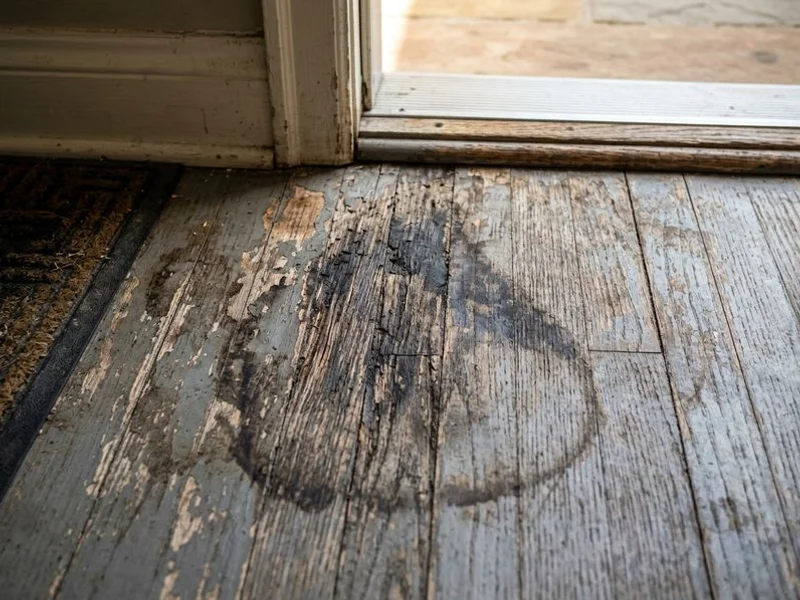
- Black stains - dark patches that have saturated through the finish and into the wood fibres. In Red Oak (the most common species in Toronto homes built between 1920 and 1970), standing water triggers an iron acetate reaction that turns the wood black. This cannot be cleaned. It requires sanding down to bare wood, oxalic acid bleaching to lift the stain, and then a full refinish sequence.
Dark staining along the base of exterior walls in Riverdale or Leslieville semi-detacheds is worth investigating further. This pattern - staining low on the wall side of the boards - often signals a slab moisture issue or failed weeping tile rather than a surface spill. Address the moisture source before refinishing or the staining will return through the new finish within a season.
Sign 5 - General dullness
A floor that looks dull and flat even after cleaning is covered in micro-abrasions - thousands of fine surface scratches that scatter light rather than reflecting it. This is normal wear. It is the earliest stage of finish degradation and the easiest to address.
If no bare wood is showing anywhere in the room and the water drop test still shows beading, a screen-and-recoat at $1-3/sq ft is the right call. The process lightly abrades the existing finish, cleans the surface, and applies 1-2 fresh coats without sanding down to bare wood. Walk-on time is the same day.
Do not attempt to restore shine with acrylic wax products - Mop & Glo, Orange Glo, or similar retail floor “restorers.” These products leave a plastic film on the surface that cannot be cleaned off with standard hardwood floor cleaners. Once that film is down, professional waterborne finishes like Bona Traffic HD cannot bond properly over it. The only fix is sanding back to bare wood, which turns a $1-3/sq ft maintenance job into a $3-8/sq ft full refinish.
Sign 6 - Finish flaking or peeling
Flaking polyurethane is adhesion failure. The finish has detached from the wood surface below and is lifting in sheets or chips. This is almost never a material defect - it is nearly always caused by incompatible products applied on top of the existing finish.
The most common culprit is retail acrylic wax (Mop & Glo is frequently found in 1990s-era homes with the original big-box polyurethane jobs). The wax penetrates the micro-pores of the finish and prevents bonding. When a new topcoat is applied on top - even by a professional who does not know the history of the floor - it peels within weeks or months.
There is no patch for peeling finish. The entire floor must be sanded back to bare wood to get below the contaminated layer, starting the grit sequence fresh from 36 grit. This is standard practice on heritage floors in Forest Hill and Lawrence Park where 1990s renovation coatings have failed on top of original 1940s-era boards.
Sign 7 - Board separation (gaps over 2mm)
Seasonal gaps in hardwood are normal. Wood expands in summer humidity and contracts in the dry winter months - a 1-2mm gap in January that closes by June is typical in Toronto homes.
Gaps wider than 2mm that stay open in summer are a different problem. They indicate the floor has lost moisture repeatedly without proper humidity control, and the boards have permanently shrunk. When this level of movement has occurred, it often means the floor has already been refinished multiple times and is approaching the minimum safe wear layer.
Lift a floor register in the affected area and measure the wood thickness above the tongue. This is the wear layer - the wood available for sanding.
- 4mm or more - two or more sands remaining. Refinishing is straightforward.
- 3mm - one more careful sand is possible. Requires an experienced operator, not a rental drum sander.
- Under 3mm - further sanding risks cutting through the tongue and destroying the board’s ability to hold its neighbour. Replacement is likely the correct call.
At under 3mm, the decision is no longer a DIY judgment call. Toronto Quality Wood Flooring measures wear layers as a standard part of every in-home estimate before any recommendation is made.
The diagnostic process: what happens during an in-home visit
A proper assessment covers three physical tests before any recommendation is made:
- Raking light inspection - viewing the floor from a low angle with a torch to reveal micro-abrasions, telegraphed subfloor movement, and previously patched areas.
- Wear-layer measurement - lifting a floor register and using a precision gauge to measure the wood above the tongue. This single number determines whether refinishing is viable.
- Moisture meter test - checking the moisture content of the boards and comparing to the subfloor. A differential of more than 4% signals active moisture movement that needs to be addressed before a new finish goes down.
These three checks take 20-30 minutes on a typical main floor. They are included at no charge as part of Toronto Quality Wood Flooring’s free in-home estimate. The written fixed-price quote follows within 48 hours.
Knowing when to stop trying to save the floor
Refinishing is the right answer in the vast majority of cases. The exceptions are straightforward once you have the measurements: wear layer under 2mm, boards with structural rot, severe cupping that has not reversed after moisture control, or a subfloor that is telegraphing through the boards. The companion guide on refinishing vs replacing hardwood floors covers those boundary cases in detail.
Get your free in-home estimate
Toronto Quality Wood Flooring provides free in-home estimates across Toronto, North York, Etobicoke, Scarborough, and the surrounding areas. The visit includes the raking light inspection, wear-layer measurement, and moisture test described above. A written fixed-price quote is delivered within 48 hours - no obligation and no pressure. Call or use the contact form to book your assessment.