The decision starts with one measurement
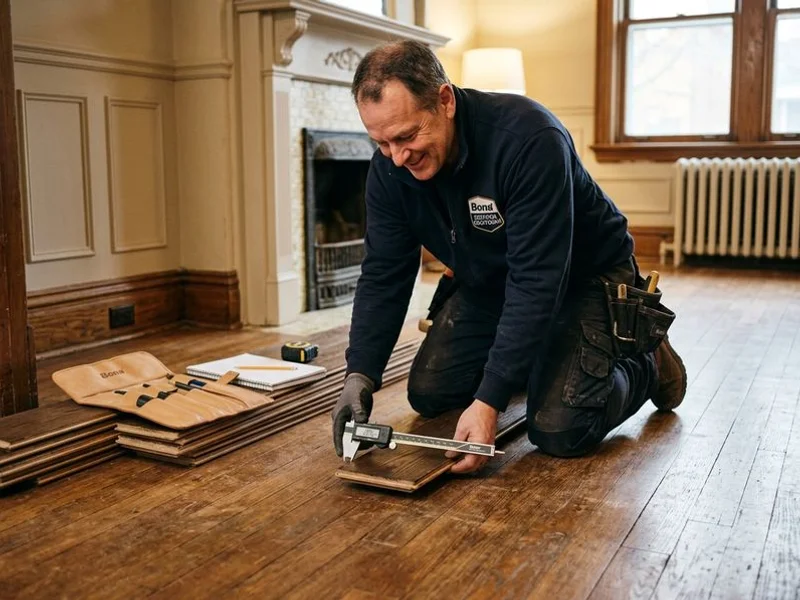
The single most important factor in the refinish-vs-replace decision is not how bad the surface looks. It is the wear layer measurement - the thickness of wood above the tongue of the board.
To check it yourself: lift a floor register in an open area of the floor. Look at the cross-section of the board from the side. The wear layer is the wood above the groove (the slot, not the tongue). Measure it with a precision gauge or a good set of calipers.
- 4-5mm - two or more sands remaining. Refinishing is the clear choice.
- 3mm - one careful sand is possible. Requires an experienced operator running a properly calibrated drum sander, not a rental machine.
- Under 3mm - further sanding risks cutting through or near the tongue. At this thickness, the drum sander will remove the remaining wood unevenly and can expose the joint at high spots.
- Under 2mm - refinishing is not viable. Replacement is the correct call.
A standard 3/4-inch solid Red Oak board starts life with approximately 6mm of wear layer above the tongue. Each full sand removes roughly 1mm. That means a floor can handle approximately 4-5 refinishes over its lifetime before replacement becomes necessary.
When refinishing clearly wins
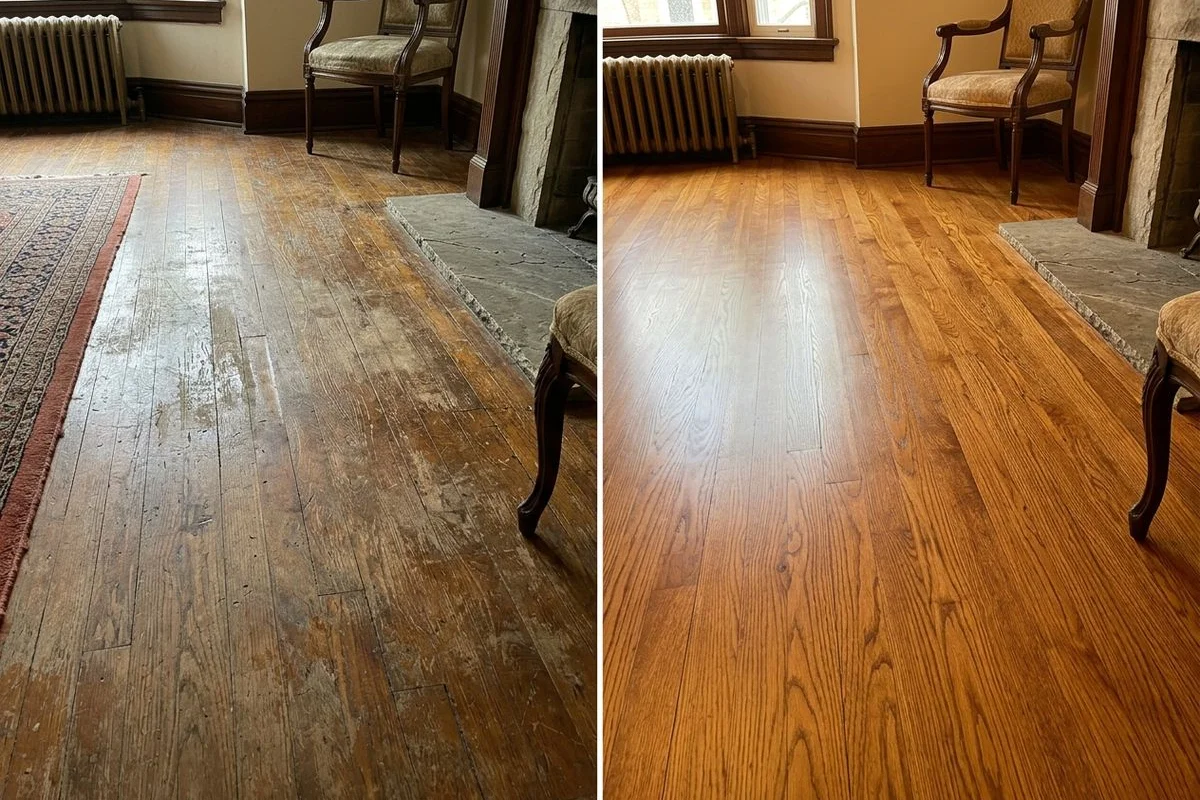
Refinishing is the right answer in the majority of cases that Toronto Quality Wood Flooring assesses. The conditions that clearly favour refinishing:
- Wear layer 4mm or more - straightforward. The floor can safely take another full 36-120 grit sequence.
- Boards structurally sound - no rot, no soft spots when walked, no widespread board failure.
- Damage is cosmetic - scratches, dullness, surface staining, or finish flaking. These are finish-layer problems, not structural ones.
- Heritage floors - original narrow-strip Red Pine, quartersawn White Oak, or old-growth Maple from pre-1940 Toronto homes. These species and cut patterns cannot be sourced new. Refinishing preserves material that cannot be replicated.
- Isolated minor staining - white surface stains and minor black iron acetate staining in isolated boards often sand out, with oxalic acid bleaching used where needed before the new stain coat goes down.
Cost comparison between refinishing and replacement is direct. Toronto refinishing runs $3-8/sq ft in 2026. New solid hardwood installation runs $10-18/sq ft for standard species. Add $1-3/sq ft for tear-up and disposal of the old floor and the total replacement cost on a 500 sq ft room is $5,500-10,500 versus $1,500-4,000 for refinishing. The gap is wide enough that refinishing is the correct economic decision for any floor that structurally supports it.
You can review the signs your floors need refinishing guide to diagnose where your floor sits on the wear spectrum before booking an assessment.
When replacement is the right call
Several conditions make refinishing either impossible or the wrong investment:
- Under 2mm wear layer - the floor has been refinished to its limit. Sanding further risks sanding into or through the tongue, which destroys the board’s ability to hold its neighbour and collapses the floor’s structural lock.
- Severe moisture cupping - boards cupped by more than 3mm that have not recovered after moisture control is restored. Minor cupping (under 1.5mm) often sands flat. Severe cupping indicates the cells in the wood have been permanently deformed by water and will not release back to flat.
- Active rot or insect damage - soft boards, boards that compress when walked on, or boards showing structural failure. No amount of sanding addresses a board that has lost its structural integrity.
- Adhesion failure on glue-down floors - glue-down installations (common in Toronto condominium buildings built in the 1990s-2000s) that have partially or fully released from the slab. Refinishing a floating floor will not re-bond the adhesive.
- Subfloor telegraphing - the subfloor’s structural movement is visible through the floor surface as persistent bouncing, deflection, or repeating squeaks across the whole floor. These require subfloor work regardless, and replacement is typically combined with that repair.
- Water damage has penetrated tongue-and-groove connections - severe water events that have caused the tongue-and-groove joints to swell and lock, or that have introduced standing moisture into the subfloor layer below.
The full replacement price range reflects the scope involved:
| Option | Typical cost/sq ft | Timeline | Heritage-safe | Adds to resale value |
|---|---|---|---|---|
| Screen-and-recoat | $1-3 | 1 day | Yes | Minor |
| Full refinish | $3-8 | 4-5 days | Yes | Yes |
| Replacement (standard species) | $10-18 | 10-14 days | No | Yes |
| Replacement (heritage match) | $18-35 | 14-21 days | Yes | Yes |
Heritage-match replacement costs significantly more because narrow-strip Red Pine, original-gauge quartersawn Oak, and other pre-war species require either salvage sourcing or custom milling. In established Toronto neighbourhoods like the Annex, Rosedale, and Cabbagetown, buyers notice when a heritage floor has been replaced with a modern substitute. Matching the original species, width, and cut is an investment that protects the character premium those properties carry.
The grey zone: 2-3mm wear layer
The 2-3mm range is where honest assessment matters most and where the wrong answer costs the most.
At 2-3mm, one more sand is sometimes possible - but it requires:
- An experienced operator with a properly calibrated drum sander, not a rental
- Careful technique at doorways and high spots where the wear layer may be thinner than the average reading
- A pre-sanding walk of the entire floor to identify areas where the tongue is already close to the surface
At 2mm specifically, the risk of exposing the tongue at high spots is material. If a board’s tongue is exposed during sanding, that board must be replaced. Replacing one or two boards mid-refinish is manageable. Discovering mid-job that 30% of the floor’s boards are at or below the safe threshold is a project that doubles in cost.
Toronto Quality Wood Flooring gives a clear recommendation on borderline floors: if the wear layer average is 2-3mm but the floor has visible high spots or the previous refinish was not level, replacement is the more predictable investment. If the floor is level and the 2-3mm reading is consistent, one final careful sand is possible.
The hybrid approach: partial replacement + refinishing
Sometimes the right answer is neither fully refinish nor fully replace - it is a combination. If 15-25% of boards in an otherwise sound floor are severely damaged (concentrated water damage near a bathroom doorway, deep pet damage in a specific zone, or boards that have failed in a high-traffic hallway), those boards can be replaced individually and the full floor can then be refinished as one surface.
Stain matching across new boards and old boards is achievable when the existing floor’s colour is known. Bona DriFast stain is adjustable by blending to hit specific targets, and the sanded new boards absorb stain at approximately the same rate as sanded old boards of the same species. On a well-matched hybrid job in a Riverdale or Leslieville semi, the repairs are not visible in normal lighting after refinishing.
Decision flowchart
Work through these questions in order:
1. Is the wear layer under 2mm? Yes - replacement is the call. Do not sand further. No - continue to question 2.
2. Is there active moisture damage, rot, or insect damage? Yes - address the moisture source first. Re-assess the wear layer and structural condition after the moisture issue is resolved. Active moisture will damage a new finish within a season if the source is not corrected. No - continue to question 3.
3. Is the subfloor telegraphing through the boards? Yes - the subfloor needs work regardless. Assess whether replacement makes sense to combine with the subfloor repair. Refinishing over a failing subfloor does not fix the underlying problem. No - continue to question 4.
4. Is the damage cosmetic? Yes - refinishing wins. Schedule the in-home assessment to confirm the wear layer and get a fixed-price quote. Unsure - book the in-home assessment. The wear layer measurement and raking light inspection will clarify it.
The in-home assessment
Toronto Quality Wood Flooring’s free in-home assessment covers the wear layer measurement at a floor register, raking light inspection to reveal subfloor movement and surface condition, and a moisture meter check of both the boards and adjacent subfloor material. If the floor is borderline, the written quote includes pricing for both options so the decision can be made with full information.
The hardwood floor refinishing service page covers what a full refinishing project looks like from the first sanding pass through to the final coat of Bona Traffic HD or Rubio Monocoat 2C.
Book your free in-home estimate
Toronto Quality Wood Flooring provides free in-home estimates across Toronto, North York, Scarborough, and Etobicoke. The written fixed-price quote is delivered within 48 hours and includes the specific scope, finish system, timeline, and both options if the floor is on the borderline. Contact Toronto Quality Wood Flooring to schedule your assessment.