What conventional floor sanding actually produces
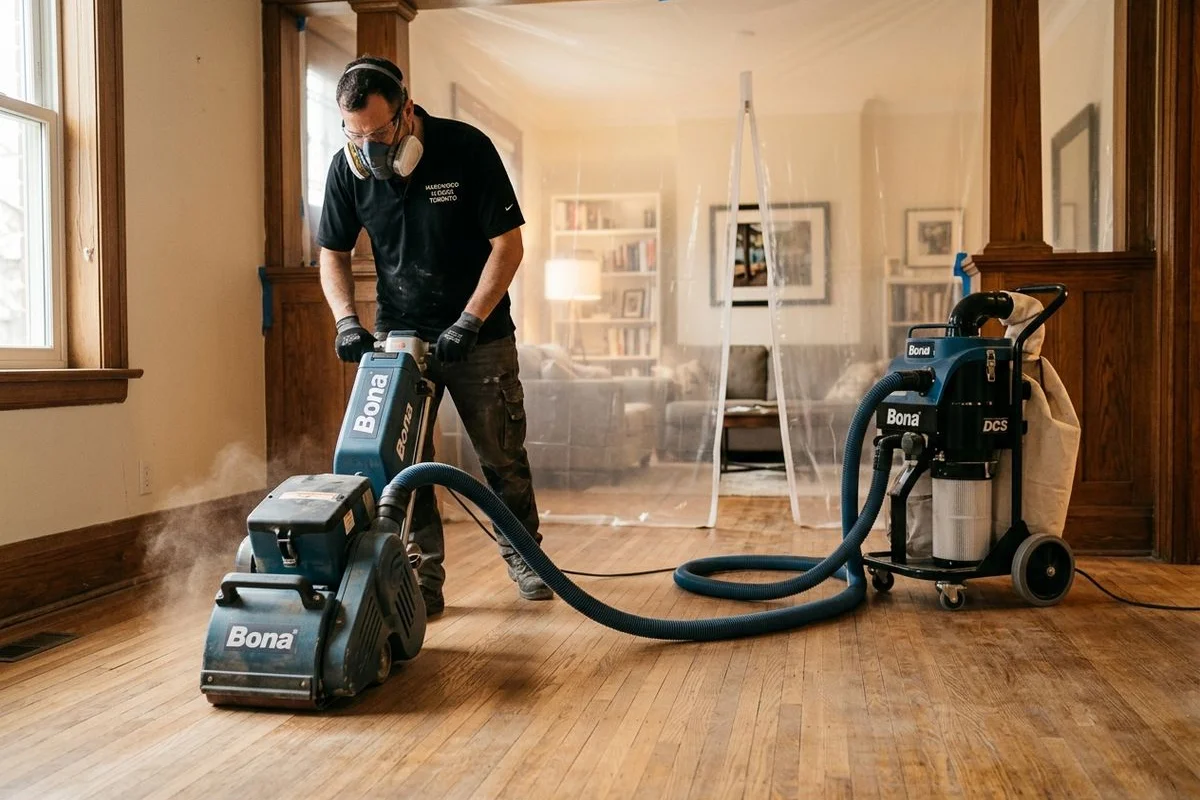
Drum-sanding a hardwood floor without containment generates 2-4 lbs of fine silica dust per 100 sq ft of floor. On a typical Toronto main floor of 800-1,000 sq ft, that is 16-40 lbs of airborne particulate produced in a single day.
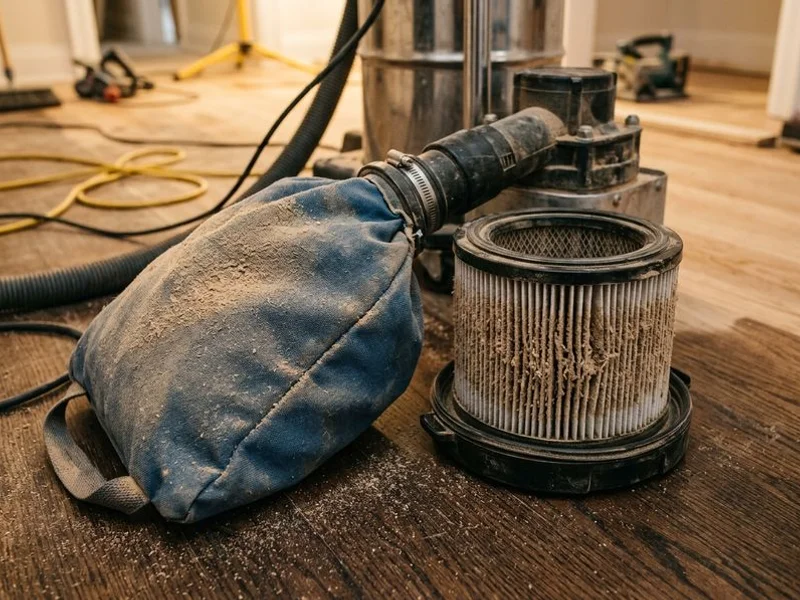
Conventional drum sanders use a porter-bag system that captures, at best, 30-50% of the dust generated at the drum head. The remainder - the lightest, finest particles - escapes into the air. From there it settles in your HVAC ducts, penetrates wall cavities, coats insulation batts, and recirculates through the system every time the furnace runs. In a Leslieville or Bloor West Village semi-detached with forced-air heating, a single uncontained sanding day can distribute fine wood dust through every room in the house within a few hours.
Standard cleanup after conventional sanding typically takes 1-2 full days. Surfaces need wiping, light fixtures come down for cleaning, HVAC filters get replaced, and duct cleaning is often required. A standard residential duct cleaning in Toronto runs roughly $350-450 in 2026.
The comparison between systems is straightforward:
| System | Dust Capture Rate | Suitable for Occupied Homes | Equipment |
|---|---|---|---|
| Conventional bag sander | 30-50% | No | Drum sander + porter bag |
| Bona Dust Containment System (DCS) | 99.8% | Yes | Drum + DCS extraction + HEPA filtration |
How the Bona Dust Containment System works
The Bona Dust Containment System is a closed-loop extraction unit that connects via sealed duct to every piece of sanding equipment on the job - the drum sander covering the main field, the belt edge sander running along walls, and the orbital buffer used for the final smoothing pass. The extraction runs continuously from the moment the cutting head engages.
Dust generated at the drum head is pulled directly into the sealed extraction unit before it can become airborne in the room. Inside the unit, a HEPA-grade filtration system captures particles rated above 0.3 microns at a 99.8% capture efficiency. The collected material drops into sealed disposal bags that are closed and removed without releasing a secondary dust cloud when emptied.
The Bona DCS is the only certified dustless system used by Bona Certified Craftsmen. The certification is not a marketing designation - it involves documented training on abrasive sequences, extraction protocol, and finish application specific to Bona products and equipment.
What DCS connects to: the full sanding sequence
Understanding the DCS requires understanding the grit sequence it operates through. Toronto Quality Wood Flooring follows the NWFA-recommended progression on every refinishing job:
- 36 grit - aggressive material removal. Strips the old finish, cuts through surface scratches, and levels high spots or cupped boards. This pass generates the highest volume of dust.
- 60 grit - medium levelling pass. Removes the deep scratch pattern left by 36 grit.
- 80 grit - smoothing pass. The floor begins to take on its final character at this stage.
- 100 grit - pre-stain surface preparation. This pass is critical if a stain is going down - the wood pores need to be open and uniform to accept colour evenly.
- 120 grit - final pass before finish coats. Removes any remaining machine marks and produces the smooth, even surface that finish bonds to.
Skipping grits is not a time-saving shortcut - it is a quality failure. Jumping from 36 grit to 80 grit leaves sub-surface scratches that the 36-grit drum cut into the wood. Those scratches do not disappear; they show through the stain and finish as a visible pattern, particularly on darker colour choices common in Rosedale and Forest Hill renovations.
The DCS extraction unit connects to the drum sander and edge sander for every grit pass. The belt edge sander handles the perimeter where the drum cannot reach - typically the 3-4 inches along walls, at doorways, and around fixed cabinetry. Hand scraping completes the corners.
What 99.8% capture means in practice
The 99.8% figure means approximately 0.2% of generated dust escapes the extraction system. On a 1,000 sq ft floor producing 20-40 lbs of dust total, that 0.2% represents 40-80 grams of fine particulate - roughly the volume of a large handful of flour - distributed across the work area over the course of a full sanding day.
That amount is manageable. It settles on horizontal surfaces in the immediate work zone and does not penetrate HVAC systems or migrate to other floors.
The DCS does not eliminate the need for basic containment measures. On every project, Toronto Quality Wood Flooring also:
- Seals doorways to adjacent rooms with poly sheeting
- Covers stairwell openings and HVAC returns
- Runs a standalone HEPA air scrubber in the active room for the duration of sanding
These supplementary steps, combined with the DCS, produce a workspace where the rooms immediately outside the work zone remain essentially clean throughout the project.
Why it matters for families with kids, pets, and asthma
Fine wood dust - the particles that conventional bag systems release into the air - falls into the PM2.5 category: particulate matter under 2.5 microns in diameter. Wood dust is classified as a Group 1 carcinogen by the IARC (International Agency for Research on Cancer) due to its documented association with sinonasal cancer in workers with prolonged exposure. Ontario WSIB workplace limits for construction wood dust are set specifically because of this classification.
For families in Leaside, the Annex, or Etobicoke homes with children under 6, pets with respiratory conditions, or adults managing asthma, a conventional sanding project is not a viable option if the home is occupied.
With Bona DCS, families routinely stay in the home during refinishing. Bedrooms on a separate floor behind closed doors remain clean. The active work zone is sealed off with poly sheeting, and the HEPA air scrubber runs continuously. Toronto Quality Wood Flooring completes projects in occupied Rosedale, Cabbagetown, and Forest Hill homes regularly under these conditions - jobs that often span 4-5 days, making hotel relocation impractical anyway.
The Bona Traffic HD finish connection
The DCS process does not just manage dust during sanding - it directly affects the quality of the finish that goes down afterward. A floor with fine dust particles remaining on the surface when the finish coat is applied will trap those particles under the polyurethane, creating a cloudy or grainy appearance under raking light.
The dust-free surface produced by Bona DCS gives Bona Traffic HD the clean substrate it requires for proper adhesion and cure. Bona Traffic HD is a waterborne commercial-grade finish with a hardener component that cross-links at the surface level - it is the same product used in commercial environments like hotel lobbies and high-traffic retail spaces. On a residential Red Oak or Maple floor in a North York or Scarborough home, it produces a finish that outlasts standard single-component polyurethane by several years under normal family traffic.
The full hardwood floor refinishing service page covers what happens between the final sanding pass and the last finish coat in more detail.
Post-sanding cleanup: the difference in real terms
After a Bona DCS project, cleanup in the active work zone takes approximately half a day. The crew runs a final HEPA vacuum pass over the work area, wipes down horizontal surfaces within the zone, and removes the poly sheeting from doorways and vents. Rooms outside the work zone typically require no cleanup at all.
After a conventional sanding project, cleanup extends to every room the HVAC system connects to - often the entire house. Light fixtures, ceiling fans, window sills, shelving, and the inside of closets all collect fine dust. HVAC filters need replacement. Duct cleaning is often added to the post-project to-do list.
The time and cost differential makes the choice clear for occupied Toronto homes.
Book a free in-home estimate
Toronto Quality Wood Flooring provides free in-home estimates with a fixed-price written quote within 48 hours. Every project includes Bona DCS setup at no upcharge - it is standard equipment on every refinishing job, not an add-on. Contact Toronto Quality Wood Flooring to schedule your estimate across Toronto, North York, Scarborough, Etobicoke, and surrounding areas.