Start with the fingernail test
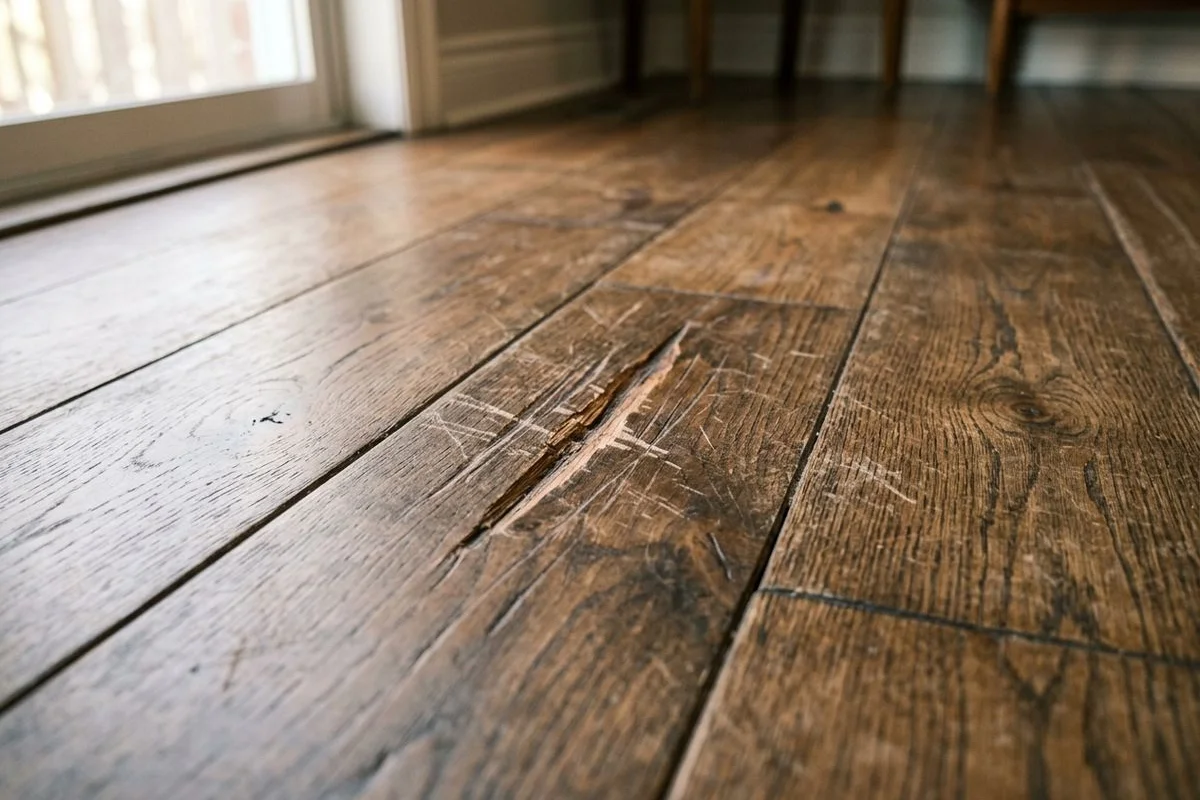
Before deciding on a repair approach for scratched or damaged hardwood, run your fingernail across the damage. This simple test determines everything:
- Fingernail does not catch: the scratch is in the finish layer only, not into the wood. This is the easier category to address.
- Fingernail catches sharply: the damage goes through the finish into bare wood. This requires a different approach entirely.
The distinction matters because finish-level scratches can be addressed with a screen-and-recoat or touch-up marker. Through-finish damage into bare wood cannot be covered with a topcoat - the bare wood acts as a sponge and new finish will not bond correctly without filling or patching the damaged area first.
See the hardwood floor repairs hub for the full range of repair services, and check our guide on when to repair vs refinish hardwood floors if the damage is widespread.
Surface scratches (finish layer only)
Surface scratches in the polyurethane or hardwax oil finish appear as light white scuffs or haze marks. They are most visible at an oblique angle under raking light. The wood beneath is undamaged - the stain colour is intact.
Touch-up markers and crayons
For very shallow, narrow surface marks: a colour-matched hardwood touch-up marker or wax crayon fills the scratch visually. These products work on isolated scuffs in low-traffic areas. The limitation is that they sit on top of the existing finish - they do not bond to it - so they wear away in high-traffic zones within months.
Screen-and-recoat
For surface scratches across a larger area or entire room: a screen-and-recoat is the correct repair. The process involves lightly abrading the existing finish surface with a floor buffer and screen pad (no sanding to bare wood), then applying one or two coats of fresh finish over the entire floor. Cost runs $1-3/sq ft.
Screen-and-recoat restores sheen uniformity and adds a protective layer without changing the colour or requiring the room to be emptied for days. The floor is typically ready to walk on within 24 hours. This is the right maintenance step for floors that look dull or show light surface wear across high-traffic paths.
Screen-and-recoat does not work if: bare wood is showing anywhere in the room, if there is wax buildup on the floor (wax prevents finish adhesion), or if the existing finish has delaminated or peeled.
Through-finish gouges (into bare wood)
Through-finish damage means the finish and wood fibres below it have been cut, crushed, or gouged. The repair approach depends on the size and depth of the damage.
Spot filler repair
For localised gouges where the surrounding floor is in good condition: colour-matched Bona wood filler or epoxy filler is worked into the gouge, sanded level, and the area is feathered with fresh finish to blend into the surrounding surface. Works well for isolated damage where the repair area is small relative to the room. Bona DriFast stain is used to match the colour of the existing floor before finish coats go down.
This is the most common repair for pet scratches that have gone through the finish, dropped-object impact dents, and furniture scrape damage that does not run the full board length.
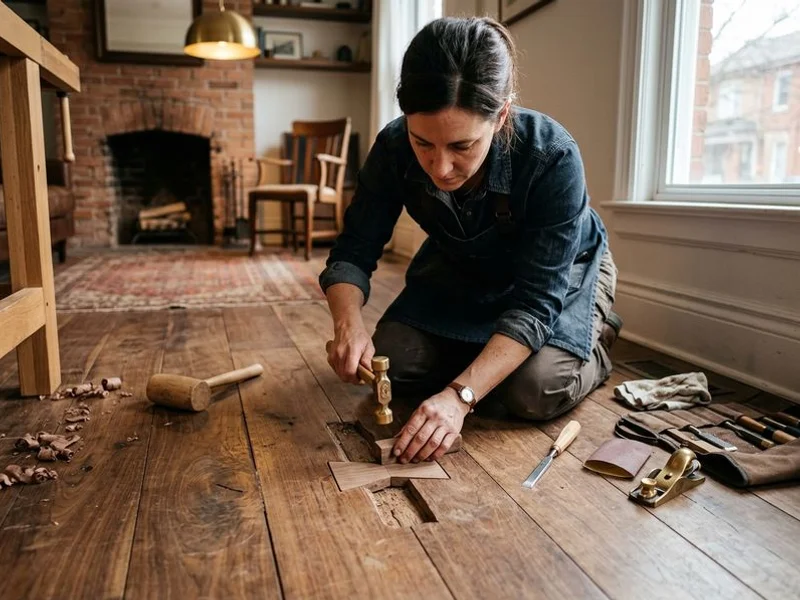
Dutchman patch
A Dutchman patch is a precisely cut piece of matching wood - shaped to the damage area - that is routed into the floor, glued, and sanded flush with the surrounding boards. The result is structurally superior to a filler repair and appropriate for larger gouges where filler alone would be visible. Wide-plank White Oak or Walnut floors benefit from Dutchman patches over filler because the grain of a good patch is less visible than a filled gouge across a wide board.
Cost: $200-600 per patch depending on size and species matching required.
Board replacement
When damage runs the full length of a board, when tongue-and-groove joints have failed, or when a board is structurally compromised: replacement is required. The damaged board is removed, a matching replacement board is installed, and the area is stained with Bona DriFast to match the surrounding floor colour before finish coats are applied.
Species, grain pattern, and current stain match all affect how visible a board replacement is. A skilled colour-match on a single board in a 600 sq ft living room in North York is nearly invisible. Six scattered replacements are harder to blend.
Cost: $300-800 per board including colour matching and spot finishing.
Pet scratches (claw marks)
Pet claw scratches are typically multiple parallel surface marks. The depth determines the repair category:
- Surface-only (finish layer): screen-and-recoat covers the area. If concentrated in one zone (near the door, in front of the feeding area), spot screen-and-recoat for that zone at $1-3/sq ft.
- Through-finish: spot filler repair for moderate claw marks. If the scratching has been severe over a large area, full refinish is more cost-effective than repairing each damaged section.
Prevention going forward: Bona Traffic HD is one of the hardest waterborne floor finishes available for residential use. Claw marks on Traffic HD are measurably shallower than on standard polyurethane at the same finish build. Specifying Traffic HD on a refinish in a home with dogs substantially extends the interval before the next refinish is needed.
Dullness (finish wear)
Uniform dullness across the whole floor - the floor looks flat and lifeless even after cleaning - is finish wear, not wood damage. This is a screen-and-recoat candidate provided no bare wood is showing.
Localised dullness concentrated in the entryway, kitchen, or a main hallway: spot screen-and-recoat for the high-wear zone. The sheen level of the fresh coat is matched to the rest of the room. This targeted approach costs less than treating the whole floor and extends the time before a full refinish is needed.
If dullness has progressed to bare wood showing through in worn spots - typically in front of the main entry, at a kitchen work triangle, or along the primary traffic path - a full sand-and-refinish is required. Screen-and-recoat will not adhere properly over sections of bare wood.
Damage type reference
| Damage type | Fingernail test | Solution | Cost range | Timeline |
|---|---|---|---|---|
| Surface scratch (finish only) | Does not catch | Touch-up marker or screen-and-recoat | $1-3/sq ft for screen-and-recoat | 1 day |
| Through-finish gouge (small) | Catches sharply | Colour-matched filler + spot finish | $150-450 per repair area | 1 day |
| Deep gouge (large) | Catches sharply, significant depression | Dutchman patch | $200-600 per patch | 1-2 days |
| Board damage (full length or structural) | Board compromised | Board replacement + colour match | $300-800 per board | 2 days |
| Uniform dullness (no bare wood) | N/A - finish wear | Screen-and-recoat | $1-3/sq ft | 1-2 days |
| Dullness with bare wood showing | N/A - finish worn through | Full sand-and-refinish | $3-8/sq ft | 4-5 days |
Toronto Quality Wood Flooring provides free in-home damage assessments for all repair enquiries. We assess the damage category, identify the correct repair method, and deliver a 48-hour fixed-price written quote. Contact us to schedule your assessment in North York, Etobicoke, Mississauga, Humber Bay, Don Mills, or anywhere in the Greater Toronto Area.
Pet Scratch Repair: Step by Step
Toronto homeowners with dogs - particularly large breeds - frequently deal with claw-pattern scratches across high-traffic areas of hardwood floors. Near the back door, in front of the feeding station, along the main corridor: these are the zones where pet claw damage concentrates. The repair approach depends entirely on whether the scratches have gone through the finish or remain in the surface layer.
Start with the credit card test rather than the fingernail test for claw marks specifically: run the edge of a credit card at a right angle across the scratched area. If it catches and drags on the marks, they are through the finish and into the wood. If it slides across without catching, the marks are in the surface finish only. This distinction determines whether a screen-and-recoat will address the problem or whether filling is required first.
Surface-level claw marks that remain in the finish layer are well suited to screen-and-recoat repair on the affected zone. The screen removes the surface gloss uniformly, the recoat fills the micro-scratches, and the zone blends back to the surrounding floor at a consistent sheen level. For scratches concentrated in one room - the living room, for example, where a dog spends most of its time - a zone screen-and-recoat at $1-3/sq ft addresses the visible damage without disturbing the rest of the floor. For through-finish claw marks where the wood fibres beneath are visibly damaged, the repair sequence is: spot fill with colour-matched Bona wood filler to level the damaged area, allow to dry fully, sand lightly, and spot recoat with Bona Traffic HD. The hardener in the two-component Traffic HD system creates a significantly harder surface than standard polyurethane once cured - future claw marks from the same dog will be shallower on a Traffic HD finish than they would be on an oil-modified polyurethane or wax finish.
Prevention going forward is a practical consideration for any home with large or active dogs. Bona Traffic HD is one of the highest commercially available abrasion ratings for residential hardwood floor finish. A floor refinished with Bona Traffic HD holds up noticeably better against dog nail traffic than the same floor would with standard polyurethane - the finish is harder and the claw marks that do form are in the finish layer rather than into the wood. Specifying Traffic HD on a refinish in a home with dogs meaningfully extends the interval before the next repair or refinish is needed.
Water Stain Repair
Water stains on hardwood floors present differently depending on how long the water was in contact with the wood and whether it reached bare wood or only the finish surface. The colour of the stain tells you where the damage is.
White stains - a cloudy, milky discolouration in the finish - indicate that moisture was trapped in the finish layer without penetrating to bare wood. This is the easiest category. Oxalic acid treatment on the affected area, or a light pass with fine steel wool and mineral spirits, can clear the white staining from the finish surface. After the stain clears, the area is spot recoated to restore the sheen. This approach works for white rings from plant pots, condensation rings from cold glasses, and similar surface-level moisture events.
Black stains are a more serious finding. The dark colouration is iron tannate - a chemical reaction between the iron compounds in the wood (especially pronounced in Oak, which has high tannin content) and prolonged moisture contact. Iron tannate penetrates through the finish into the wood fibres and cannot be removed from the surface alone. The repair requires sanding back to bare wood, applying an oxalic acid wash to neutralise and lighten the staining, rinsing and neutralising the acid, allowing 48 hours of drying time, and then restaining and refinishing the affected area. For black staining that has penetrated the full thickness of the board, oxalic acid treatment improves but may not fully eliminate the discolouration - board replacement is sometimes the cleaner option when the staining is severe and confined to identifiable boards.
Yellow or orange discolouration under area rugs is a UV differential issue rather than a moisture stain. The wood under the rug has been shielded from UV light while the surrounding floor has lightened over time - or in some species (like Cherry), the covered area has not undergone the same UV-driven darkening as the exposed floor. The result is a rug outline visible on the floor once the rug is moved. Oxalic bleach treatment can sometimes reduce the differential, but the most reliable solution is a full refinish that sands the floor to bare wood uniformly and applies fresh stain and finish across the entire surface. Matching the differential through spot work alone is difficult.
When Dullness Is a Sign of a Bigger Problem
Localised dullness in one room - the living room is dull while the rest of the floors look fine - is normal finish wear and a straightforward screen-and-recoat candidate. The finish in that zone has been abraded by grit and traffic, and a fresh coat restores the sheen. This is routine maintenance, not a warning sign.
Progressive dullness that returns within months of a professional screen-and-recoat is a different problem. If a floor was recoated six months ago and is already looking dull and patchy, the issue is likely finish adhesion failure caused by a contaminating product on the floor. Retail cleaning products marketed as floor “refreshers” or “shine restorers” - Mop and Glo, Orange Glo, Murphy’s Oil Soap used repeatedly, and various acrylic topcoat sprays - leave a residue on the floor surface that prevents professional finish from bonding correctly. The new recoat sits on top of the contaminating layer rather than bonding to the existing finish, and it wears away in a matter of months rather than years. The solution is a solvent wipe or chemical stripping process to remove the contaminating layer from the floor surface, followed by a proper screen-and-recoat with a compatible finish system. Once the floor is clean of contamination, the new finish bonds correctly and lasts as it should.
Dullness that presents as a bubbling or fish-eye pattern in the finish - visible under raking light as small circular imperfections in the finish surface - indicates moisture migrating upward through the finish from below. This is a substrate moisture problem, not a surface finish problem. The finish is being pushed up from underneath as vapour tries to escape through the floor. Screen-and-recoat will not fix this; the new coat will show the same pattern within weeks. The floor must be sanded back to bare wood, the substrate moisture source must be identified and corrected, and fresh finish must be applied after moisture readings confirm the wood is at equilibrium moisture content.
Free In-Home Assessment
Toronto Quality Wood Flooring provides free in-home damage assessments for all scratch, gouge, stain, and dullness repair enquiries. We identify the damage category, assess the correct repair approach, and provide a 48-hour fixed-price written quote with no obligation. Contact us to schedule your assessment anywhere in the Greater Toronto Area.