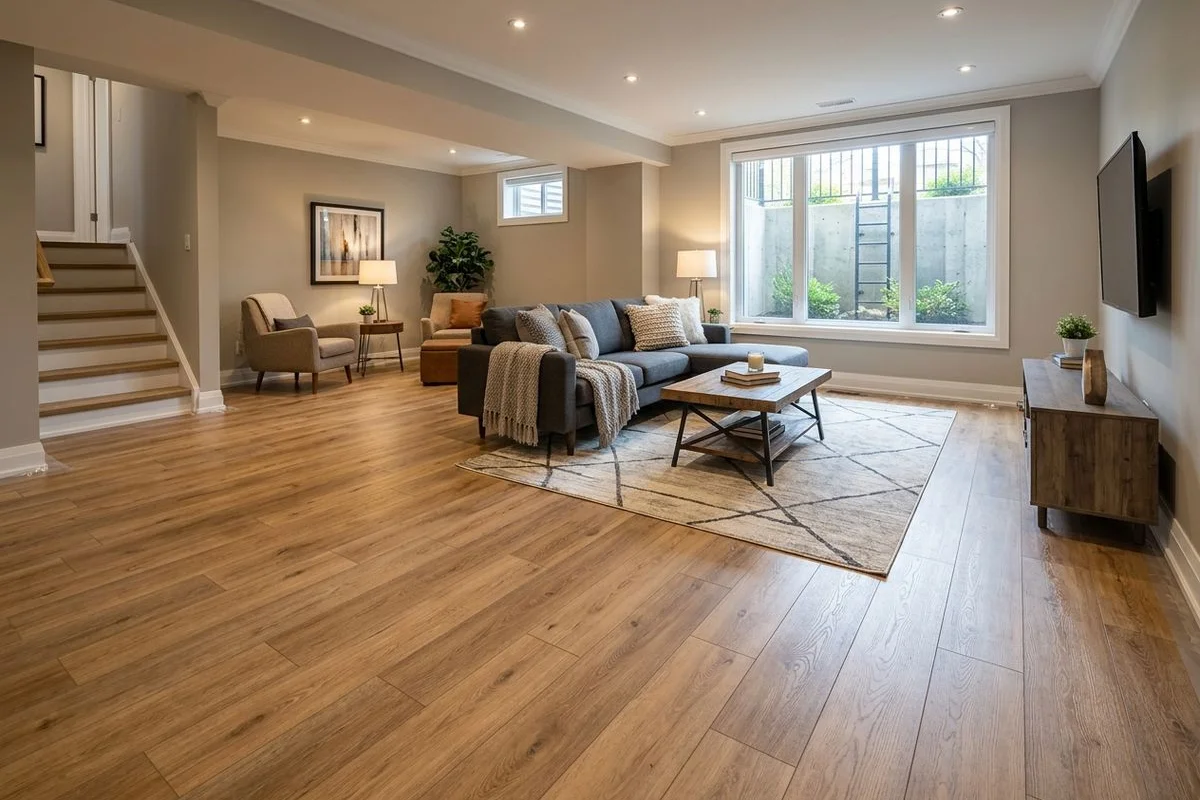
Toronto basement moisture: what you are actually dealing with
Most Toronto homes built before 1985 have poured concrete or concrete block basement walls with minimal exterior waterproofing by today’s standards. In spring and summer, moisture vapour transmits through the concrete mass into the basement air. Below-grade humidity in Toronto basements without active dehumidification runs 65-80% relative humidity during summer months - well above the 50% threshold most flooring products specify.
This is not a building defect. It is the reality of Toronto’s geology and climate. The city sits on clay-rich lakeshore deposits that hold groundwater at relatively high levels, and the freeze-thaw cycle of a Toronto winter followed by spring snowmelt creates reliable seasonal moisture pressure against basement foundations.
Any laminate installed in a Toronto basement must be specified for this environment. Standard laminate is not. The wrong product in a Toronto basement can fail within two to three seasons.
Toronto Quality Wood Flooring installs laminate below grade with the correct specification. Our laminate flooring page covers the full service. If you are also considering vinyl, our LVP for Toronto basements guide provides a direct comparison of the two products for below-grade use.
Why standard laminate fails in Toronto basements
Standard HDF-core laminate is not waterproof. The high-density fibreboard that forms the structural core of most laminate products absorbs moisture when exposed to water, and the swelling is not reversible.
Two distinct failure modes occur in Toronto basements:
Flooding events: A sump pump failure, basement window seal failure, or drain backup can put 1-5cm of water across a basement floor within hours. When standard laminate sits in standing water, the HDF core begins absorbing through the plank bottoms and through the seams within the first few hours. Once saturated, the core swells permanently. The planks cup, the seams gap, and the floor cannot be dried and reinstalled - it must be replaced entirely.
Chronic humidity swelling: Even without a flooding event, the sustained humidity of a Toronto summer causes standard laminate to swell at the seams (edge-swelling). The edges of adjacent planks rise slightly relative to each other, creating “lips” between boards. These lips trap dirt and become trip hazards, and they cannot be flattened without replacement.
What “moisture-resistant” laminate actually means
The term “moisture-resistant” covers a range of product specifications. Understanding the distinction matters for Toronto basement use.
Edge-treated HDF core laminate - products like Pergo Extreme, Quick-Step Exquisa, and Aqua-Step use a HydroSeal, Aquaprotect, or similar edge treatment that applies a wax or polymer coating to the plank edges and bottom. This treatment significantly slows moisture ingress through seams. These products are appropriate for Toronto basements with controlled humidity and no flooding history. They are still not waterproof - sustained standing water will eventually penetrate them.
Waterproof-core laminate - a newer product category using a waterproof substrate (vinyl or glass-fibre core) instead of HDF. Quick-Step Livyn, Mohawk RevWood Plus, and similar hybrid products blur the line between laminate and LVP. These products are genuinely waterproof through the core and edges. They perform like LVP in moisture situations while maintaining the visual and acoustic qualities of traditional laminate.
Standard HDF laminate - not appropriate for any below-grade installation in Toronto, regardless of the product’s surface rating or AC class.
Vapour barrier requirements
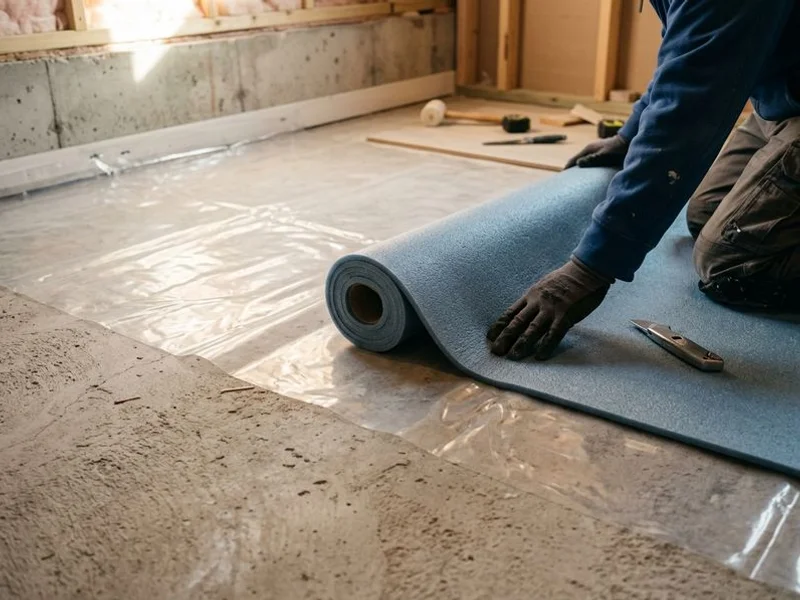
Any laminate installed on a concrete slab in a Toronto basement requires a proper vapour barrier. This applies even to moisture-resistant products.
The minimum specification is 6-mil polyethylene sheeting, with joints overlapped 200mm and taped with vapour-barrier-grade tape. The sheeting should run 50mm up the walls before being trimmed behind the baseboard.
Before installation, a slab moisture test is strongly recommended. The ASTM F2170 protocol uses in-situ probes installed in drilled holes in the concrete and read after 24-72 hours to determine internal slab relative humidity. For standard moisture-resistant laminate, the slab RH should read below 75% before installation proceeds. Readings above 80% indicate that the slab requires active moisture mitigation (drainage membrane, epoxy moisture barrier coating) before any floating floor can be installed.
Some premium underlayment products include integrated vapour barriers (Quick-Step Combi-Floor, Pergo Gold underlayment). Where these are specified, the separate 6-mil poly sheet is not required - the integrated product replaces it. Do not stack both products, as the additional cushion creates a “stack effect” that stresses click-lock joints over time.
Comparing moisture-resistant laminate to LVP for Toronto basements
This is the most common decision point for homeowners finishing a Toronto basement. Both materials are appropriate, but they suit different risk profiles.
| Factor | Moisture-Resistant Laminate | SPC Rigid-Core LVP |
|---|---|---|
| Waterproof rating | Resistant only (edge-treated HDF) | Fully waterproof (stone-plastic core) |
| Performance in standing water | Will eventually swell at seams | Undamaged by standing water |
| Slab RH tolerance | Up to 75-80% | Up to 95% |
| Material cost | $2-4/sq ft | $2-6/sq ft |
| Installed cost | $3-5/sq ft | $4-8/sq ft |
| Acoustic quality | Warmer sound, slightly higher IIC | Colder sound without acoustic underlayment |
| Thermal comfort | Slightly warmer underfoot | Colder (vinyl thermal mass) |
| Appropriate for basement with flood history | No | Yes |
| Appropriate for dry, dehumidified basement | Yes | Yes |
The decision framework is straightforward:
- Basement with no history of water intrusion, active dehumidification that keeps summer RH below 60%, and no adjacent plumbing fixtures: moisture-resistant laminate (Quick-Step Exquisa, Pergo Extreme) is a reasonable, cost-effective choice.
- Basement with any history of water intrusion, drain backup, sump pump issues, or high seasonal humidity without reliable dehumidification: SPC rigid-core LVP is the safer specification. The cost difference is approximately $1-3/sq ft installed - meaningful but not the primary consideration when the alternative is replacing the floor after a water event.
Recommended products for Toronto basements
Based on our installation experience in Toronto-area basements, the products that perform reliably in below-grade conditions with proper installation include:
Moisture-resistant laminate:
- Quick-Step Exquisa - 12mm, HydroSeal edge treatment, AC4 wear layer
- Pergo Extreme - 12mm, Titanium X edge protection, AC4
- Aqua-Step V4 - fully waterproof core (glass-fibre substrate), 4mm, AC4
For basements where waterproof construction is preferred but laminate aesthetics are wanted:
- Quick-Step Livyn (vinyl-core laminate hybrid)
- Mohawk RevWood Plus (waterproof HDF core with Hydroseal)
All of the above require the vapour barrier and moisture testing protocol described above, regardless of the product’s moisture rating.
What we install in Toronto basements
Toronto Quality Wood Flooring specifies AC5 moisture-resistant laminate at 12mm thickness for standard recreational basement installations - rec rooms, home offices, guest bedrooms. For kitchens, laundry areas, or any basement with plumbing overhead, we recommend SPC LVP rather than any laminate product.
Installed pricing for moisture-resistant laminate in Toronto basements currently runs $3-6/sq ft for the complete installation including vapour barrier, acoustic underlayment, click-lock installation, and transitions. This does not include subfloor levelling if required.
Get your in-home estimate
Toronto Quality Wood Flooring provides free in-home consultations including a slab moisture assessment and product recommendation for your specific basement conditions. We return a fixed-price written quote within 48 hours that itemises every component of the installation.
Contact us to schedule your assessment before selecting a product.