Understanding what each product actually is
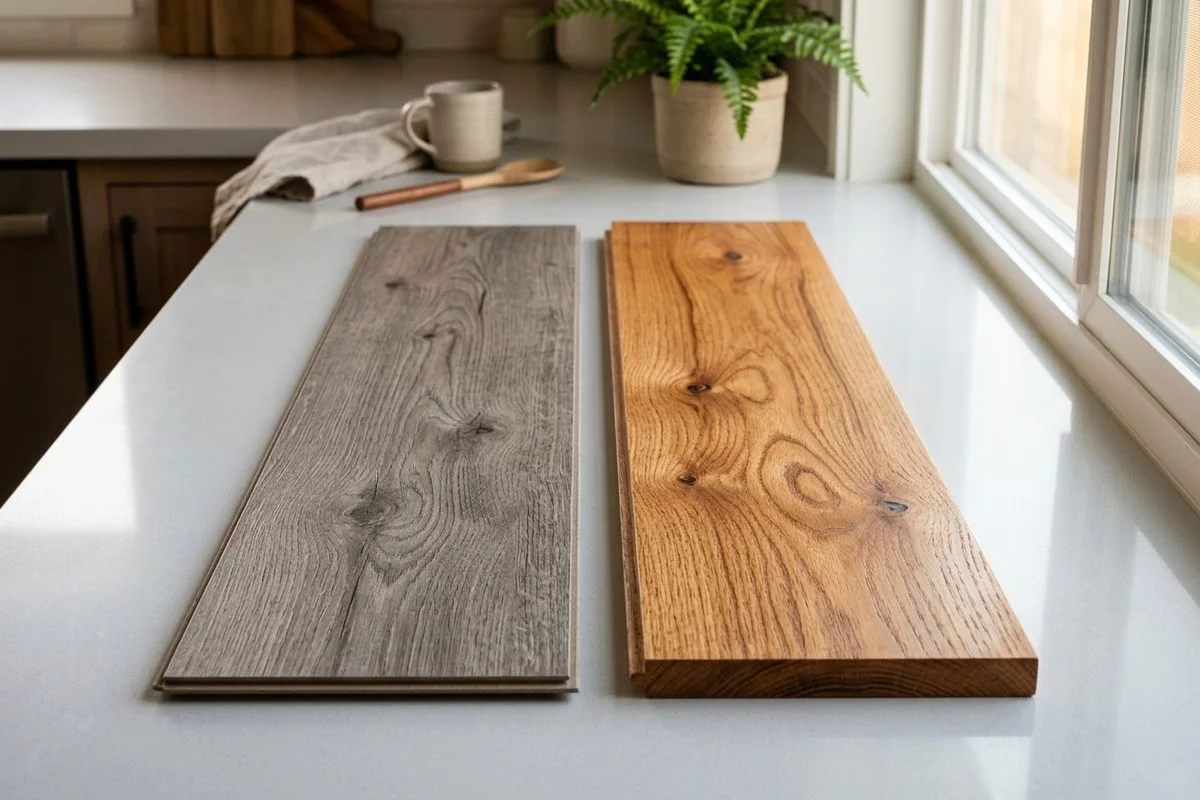
Before comparing laminate and hardwood, it helps to be clear about what each product is made of. These are structurally different products, and the differences in construction explain most of the differences in performance.
What modern laminate is: High-density fibreboard (HDF) core with a photographic wear layer that mimics wood grain. The image layer is a high-resolution photograph of real wood, laminated under a melamine wear layer. AC ratings (AC1 through AC5) describe abrasion resistance - AC3 handles light residential use; AC4 handles heavy residential and light commercial use; AC5 handles commercial traffic. The product contains no real wood. When the wear layer is exhausted, the floor must be replaced.
What real hardwood is: Either solid (3/4 inch one-piece wood throughout) or engineered (real hardwood veneer bonded over a plywood or HDF core). Both products contain actual wood fibres. Solid hardwood can be sanded and refinished 4-6 times over its life. Engineered hardwood with a 3-6mm wear layer can typically be refinished 1-3 times. Both develop natural character and patina over decades of use.
This structural difference explains every downstream performance difference between the two products.
Toronto Quality Wood Flooring installs both materials across the GTA. The right choice depends on the room, the home’s context, and the ownership timeline. Our laminate flooring page covers the installation service in detail, and our LVP vs laminate vs hardwood guide adds a third option for comparison.
The five key performance differences
1. Refinishing
This is the defining functional difference between the two materials. Real hardwood can be sanded and refinished. Laminate cannot.
Solid 3/4 inch hardwood can be refinished 4-6 times over its life - roughly every 15-20 years with normal residential use. Each refinishing removes approximately 1mm of wood. Engineered hardwood with a 3mm wear layer supports 1-3 refinishes; a 6mm wear layer supports 3-4.
Laminate has no wood to sand. When the melamine wear layer develops deep scratches or dullness, the floor requires full replacement. There is no intermediate step.
In cost terms: refinishing 1,000 sq ft of hardwood in Toronto currently runs $3,000-6,000. Replacing 1,000 sq ft of laminate runs $5,000-12,000 depending on the product and conditions. Over a 50-year ownership period, a hardwood floor that is refinished twice costs less in total maintenance than laminate replaced twice.
2. Resale value
Real hardwood floors are consistently cited by Ontario real estate professionals as a top-10 renovation return-on-investment feature. In Rosedale, Forest Hill, Lawrence Park, and Leaside, buyers entering a home with real hardwood recognise it immediately, and it affects offers.
Laminate is not noted as a value-add in Toronto home listings. In premium neighbourhoods, laminate where buyers expect hardwood can actually be a slight negative - it signals a missed opportunity or a budget constraint.
In mid-market Toronto neighbourhoods, laminate is value-neutral. It does not hurt the sale, but it does not help it either.
3. Appearance and feel underfoot
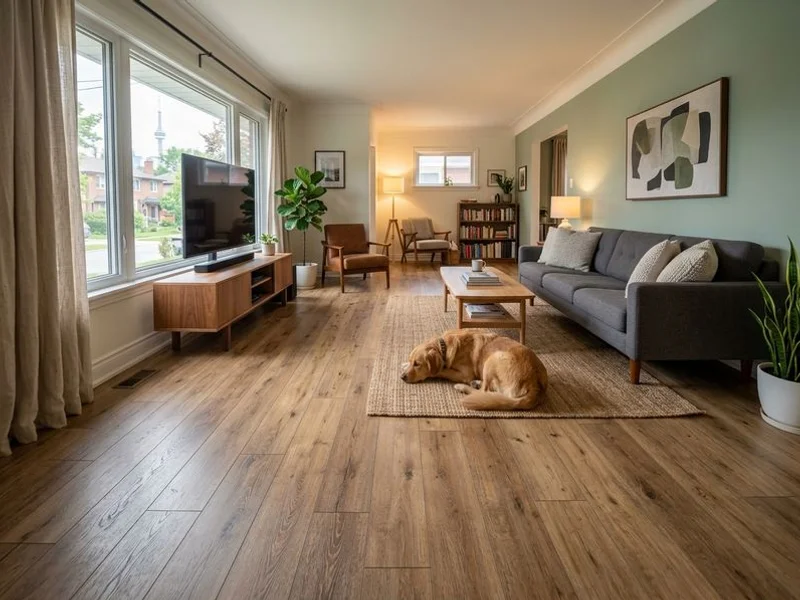
Modern AC4 and AC5 laminate from brands like Quick-Step, Pergo, and Mohawk RevWood has improved substantially. From a standing distance in normal room lighting, quality laminate is visually convincing. The photographic layer captures grain and colour well.
The difference becomes apparent in two ways. First, the surface texture: high-end laminate has embossed texture, but it is uniform across the entire board run - there is no natural variation in texture that real wood produces. Second, the feel underfoot: floating laminate has no air gap between the plank and the subfloor. This produces a slightly hollow, uniform feel that real wood (particularly glue-down or nail-down hardwood) does not have. The sound when walking on it is also slightly different.
Real wood has natural temperature variation - it warms up underfoot during the day. Laminate is more uniform.
4. Moisture tolerance
Laminate’s HDF core is moisture-sensitive. Water that enters through seams - from a drain overflow, a spilled glass left to sit, or a mudroom boot puddle - causes the HDF to swell. Once swollen, HDF does not return to its original form. The result is raised edges at joints, which trap dirt and create tripping hazards.
This limits laminate’s appropriate applications. It is not suitable for bathrooms. It requires a proper 6-mil polyethylene vapour barrier on any concrete slab. In mudrooms and laundry rooms, moisture-resistant laminate with edge sealing (Aquastop-type treatments) is the minimum viable specification, and even then it is a compromise compared to luxury vinyl plank (LVP).
Real hardwood (solid) is also moisture-sensitive and not appropriate for below-grade use without careful management. Engineered hardwood is more moisture-tolerant but still not waterproof. Neither hardwood product belongs in a bathroom.
5. Lifespan
AC4 laminate in residential use: 15-25 years under normal conditions. AC5 commercial-grade laminate: up to 25 years in residential settings.
Hardwood (properly maintained): 50-100 years with 2-3 refinishes. There are hardwood floors in Rosedale and Forest Hill homes built in 1910 that are still the original installation, refinished twice and still performing well.
Where laminate is the right call
Laminate is not the wrong choice - it is the right choice for specific situations:
- Rental units: No budget or intention to refinish. Tenants want a clean, presentable floor. AC4 or AC5 laminate handles turnover well and can be replaced affordably when required.
- Basement recreational rooms: With moisture-resistant specification and a proper vapour barrier, AC5 laminate in a climate-controlled basement is a reasonable choice at lower cost than LVP. Not appropriate where flood risk exists.
- High-traffic secondary rooms in family homes: Mudrooms, children’s playrooms, and laundry rooms where hardwood would need refinishing within 3-5 years due to concentrated wear.
- Short-term staging for sale: Laminate looks like hardwood in listing photos and costs $3-6/sq ft installed versus $12-22/sq ft for hardwood. For a home being sold within 12-24 months, laminate can produce a presentable result at much lower cost.
Where hardwood is the right call
- Main living areas, dining rooms, and primary bedrooms in any home where long-term ownership is the plan. The refinishability means the floor grows with the house.
- Heritage homes in Victorian, Edwardian, or Georgian-era architecture. Laminate reads as obviously incorrect in rooms with original mouldings, plaster ceilings, and period-correct trim. The grain repeat pattern in laminate is identifiable to anyone who has seen both materials.
- Premium neighbourhoods where resale value matters: Rosedale, Forest Hill, Lawrence Park, Leaside, Moore Park, Summerhill. Buyers in these markets notice the difference.
- Any room where the floor will be lived on for 30 or more years. The refinishing cycle means the floor can be restored to near-new condition multiple times within that window.
Full comparison at a glance
| Attribute | AC4 Laminate | Engineered Hardwood | 3/4” Solid Hardwood |
|---|---|---|---|
| Material cost | $2-4/sq ft | $6-14/sq ft | $4-8/sq ft |
| Install cost | $2-4/sq ft | $4-10/sq ft | $4-8/sq ft |
| Total installed | $4-8/sq ft | $10-24/sq ft | $8-16/sq ft |
| Refinishable | No | 1-3 times (3-6mm wear layer) | 4-6 times |
| Lifespan | 15-25 years | 30-50 years | 50-100 years |
| Resale value contribution | Minimal to neutral | Moderate | High |
| Moisture resistance | Moderate (not waterproof) | Moderate (not waterproof) | Low |
| Below-grade appropriate | With moisture-resistant spec + vapour barrier | With ASTM testing + vapour barrier | No |
| Feel underfoot | Slightly hollow (floating) | Solid | Solid |
The long-term cost calculation
The cost-per-year-of-life comparison is the clearest way to evaluate whether laminate is actually cheaper than hardwood over time.
Laminate at $6/sq ft installed with a 20-year lifespan = $0.30/sq ft/year.
Solid hardwood at $14/sq ft installed with a 70-year lifespan (refinished twice at $4/sq ft each) = total investment $22/sq ft over 70 years = $0.31/sq ft/year.
The numbers are virtually identical on a per-year basis. Hardwood also retains resale value; laminate does not. When the resale value contribution is factored in, hardwood is demonstrably the lower long-term cost option in a home where ownership extends beyond 15-20 years.
The exception is secondary rooms and rentals where the ownership timeline or expected wear rate changes the calculation. In those contexts, laminate’s lower upfront cost is the right financial decision.
Talk to us before you decide
Toronto Quality Wood Flooring offers free in-home consultations where we assess the specific room, the home’s context, and the ownership plan before making a recommendation. In many homes, the right answer is a combination of both materials: hardwood on the main floor, laminate or LVP in the basement.
We provide fixed-price written quotes within 48 hours of the in-home visit. Contact us to schedule your assessment.