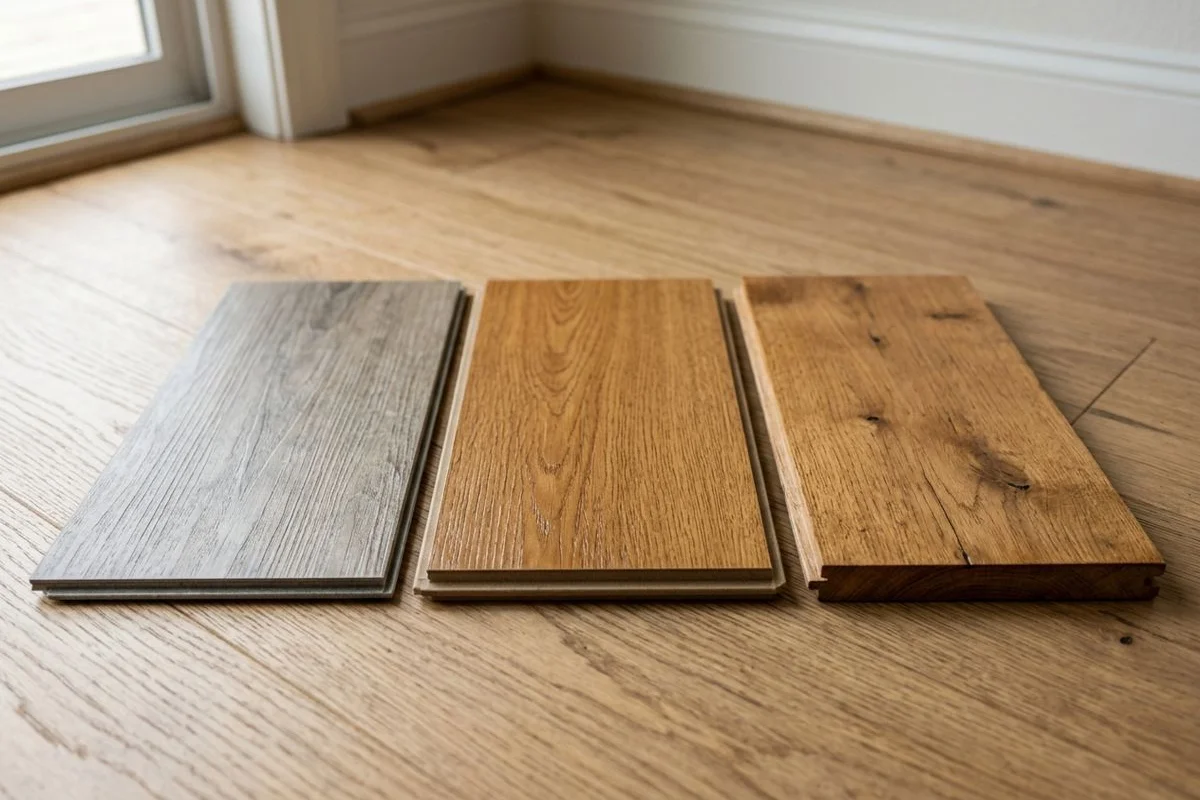
Three products, three different jobs
Luxury vinyl plank (LVP), laminate, and hardwood compete for the same floor space in most Toronto renovation conversations, but they are not interchangeable. Each product is built differently, performs differently in moisture situations, and suits different rooms and ownership timelines.
The most common planning mistake is treating them as versions of each other rather than as distinct products with distinct strengths. LVP is 100% synthetic - it contains no wood and is genuinely waterproof throughout. Laminate is a photograph of wood grain over an HDF core - it looks like wood but cannot be refinished and is not waterproof. Hardwood is real wood - either solid or engineered with a real veneer - and it can be refinished, develops character over time, and contributes measurably to resale value in Toronto’s premium neighbourhoods.
Toronto Quality Wood Flooring installs all three products across the GTA. Our luxury vinyl plank flooring hub covers LVP service in detail. For a two-way comparison, our laminate vs hardwood guide goes deeper on that specific decision. This guide covers the full three-way comparison by construction, performance, cost, and room suitability.
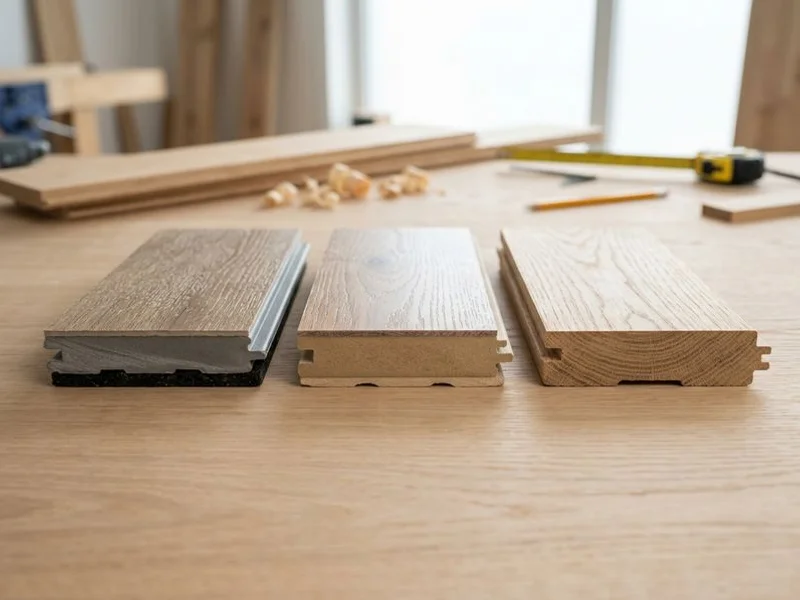
Construction: what each product is actually made of
Understanding the construction of each product explains every performance difference downstream.
LVP (SPC rigid core): Stone Plastic Composite core - a dense mineral-filled layer of limestone powder and PVC that is 100% waterproof throughout. Above the core is a printed design layer (photograph of wood or stone) covered by a clear wear layer of 12-28 mil thickness depending on residential or commercial grade. The product contains no wood fibre. COREtec, Karndean, Shaw Floorté, and LifeProof are the most commonly specified SPC brands in the Toronto market.
Laminate: High-density fibreboard (HDF) core, which contains wood fibre and is moisture-sensitive. A high-resolution photographic wear layer is laminated under a melamine surface. AC ratings (AC3-AC5) describe abrasion resistance. Quick-Step, Pergo, and Mohawk RevWood are common brands. The product looks like wood but contains no real wood that could be refinished.
Engineered hardwood: Real hardwood veneer (2-6mm thick) bonded to a multi-ply plywood or HDF core. The veneer is real wood and can be sanded and refinished within its thickness limits. More dimensionally stable than solid hardwood, making it suitable for radiant heat and basement installations (with proper moisture testing).
Solid hardwood: One solid piece of wood throughout, typically 3/4 inch thick. The most refinishable option (4-6 times over its life). Not suitable for below-grade installation. European White Oak, American Black Walnut, and Hard Maple are the most common species in GTA residential work.
Water resistance: the most important factor for Toronto basements
Toronto’s freeze-thaw cycle, seasonal groundwater pressure, and spring snowmelt mean that most basements experience some degree of seasonal moisture. A single sump pump failure or floor drain backup can cover a basement floor with 1-3cm of water. The three categories of flooring respond to this very differently.
LVP (SPC): Genuinely waterproof throughout the core. Standing water on LVP for hours - or days - will not penetrate or damage the plank. Dry off the surface and the floor is undamaged. This is the defining advantage of LVP for Toronto basement use.
Moisture-resistant laminate: Resistant, not waterproof. Products like Pergo Extreme and Quick-Step Exquisa use edge treatments that significantly slow moisture ingress, but the HDF core will still swell if water sits on the seams for extended periods. Appropriate for climate-controlled basements with no flood history; not appropriate where water events are possible.
Engineered hardwood: The wood veneer is not waterproof. Engineered hardwood handles ambient below-grade humidity better than solid hardwood (with proper vapour barrier and ASTM F2170 moisture testing), but standing water will damage it.
Solid hardwood: Not rated for below-grade installation. Not appropriate in basements.
Visual realism: how close is LVP to real hardwood in 2026?
High-end SPC LVP from COREtec, Karndean Korlok, and Shaw Floorté (20-mil wear layer, embossed-in-register texture) is visually convincing at normal standing distances. The embossed-in-register manufacturing process creates a surface texture that corresponds precisely to the printed grain underneath - the result is tactilely as well as visually close to real wood.
Budget LVP (under $2/sq ft material) has visible grain repeat patterns and flat surface texture that are identifiable at close range and in raking light.
Premium laminate from Quick-Step, Pergo, and Mohawk RevWood reaches a similar quality level to mid-tier LVP in terms of visual realism, with grain photography that is convincing at normal viewing distances.
Neither product achieves the natural variation that real wood develops over time - the colour shift, the grain irregularity at knots and figure, the way the surface picks up light differently across the width of a board. In heritage rooms in Rosedale or Forest Hill, real hardwood reads as authentically appropriate in a way that either synthetic product does not.
Refinishability: the 30-year factor
This is the most important long-term performance differentiator, and it is often underweighted in short-term cost comparisons.
Solid hardwood can be sanded and refinished 4-6 times over its life - roughly every 15-20 years. Each refinishing removes approximately 1mm of wood and restores the surface to near-new condition. A hardwood floor purchased in 2026 at $14/sq ft installed and refinished twice at $4/sq ft each in 2041 and 2056 has a 60-year total cost of $22/sq ft.
Engineered hardwood with a 3mm veneer supports 1-2 refinishes. With a 6mm veneer, 3-4 refinishes are achievable. The veneer thickness is the limiting factor.
LVP cannot be refinished under any circumstances. When the wear layer is exhausted - typically 20-30 years in residential use - the floor is replaced.
Laminate cannot be refinished. When the melamine wear layer wears through - typically 15-25 years depending on AC rating - the floor is replaced.
For a 30+ year ownership horizon, the refinishability of hardwood makes its higher initial cost competitive on a per-year-of-use basis. For shorter ownership timelines or secondary rooms where wear is concentrated, the inability to refinish LVP or laminate is an acceptable trade-off.
Sound and thermal comfort
Floating LVP and laminate both produce a slightly hollow sound underfoot without acoustic underlayment, and a notable improvement with quality cork or rubber underlayment. IIC ratings of 50-58 are achievable with the right underlayment combination. Many Toronto condominium buildings require a minimum IIC rating; this must be specified in advance.
Nail-down or glue-down hardwood transmits less hollow sound because there is no air gap between the board and the subfloor. The floor feels and sounds more solid underfoot.
Thermal comfort: Real wood is a good thermal insulator and feels relatively warm underfoot compared to vinyl or laminate. LVP has vinyl’s thermal mass and feels noticeably colder underfoot, particularly in basements. This can be addressed with radiant in-floor heat under SPC LVP (check manufacturer temperature limits, typically 27°C maximum). Laminate is similar to LVP in thermal feel.
Full three-way comparison
| Attribute | LVP (SPC) | Moisture-Resistant Laminate | Engineered Hardwood | Solid Hardwood |
|---|---|---|---|---|
| Waterproof | Yes (fully) | Resistant only | No | No |
| Below-grade rated | Yes | With vapour barrier | With ASTM testing | No |
| Refinishable | No | No | 1-3 times (3-6mm wear) | 4-6 times |
| Material cost | $2-6/sq ft | $2-4/sq ft | $6-14/sq ft | $4-8/sq ft |
| Install cost | $3-6/sq ft | $2-4/sq ft | $4-10/sq ft | $4-8/sq ft |
| Lifespan | 20-30 years | 15-25 years | 30-50 years | 50-100 years |
| Resale value contribution | Minimal | Minimal | Moderate | High |
| Thermal comfort | Cold (vinyl) | Cold (vinyl-like) | Warm | Warm |
| IIC sound (with underlayment) | 42-65 dB | 40-58 dB | 45-58 dB | 50-62 dB (glue/nail down) |
Room-by-room recommendations
Basement (any Toronto basement): LVP with SPC core. Waterproof construction handles moisture events that will eventually occur in most Toronto basements. COREtec Plus HD (20-mil wear layer) is the most common specification for Toronto finished basements.
Bathroom: LVP only. No other flooring category belongs in a bathroom.
Kitchen: LVP or engineered hardwood (above grade, properly sealed). LVP if moisture management is a concern; hardwood if resale value and aesthetics in the kitchen are priorities.
Main living room and dining room: Solid or engineered hardwood. These are the rooms where resale value is established and where authentic material reads correctly in both heritage and contemporary homes.
Primary bedroom: Solid or engineered hardwood. Comfortable, quiet, long-lived, and appropriate for the room.
Children’s playroom, family room: LVP or AC4/AC5 laminate. High wear, concentrated use, and spill risk make synthetic products appropriate here. Hardwood can be used if budget permits and occasional refinishing is acceptable.
Rental unit (full property): LVP or AC4 laminate throughout. Durability under tenant turnover and the ability to clean thoroughly make synthetic products the practical choice.
Get a recommendation for your specific home
Toronto Quality Wood Flooring provides free in-home consultations where we assess each room’s moisture conditions, subfloor type, and usage context before making product recommendations. Most Toronto homes are best served by a combination of materials - hardwood on main floors, LVP in basements and kitchens, laminate in secondary spaces where budget sensitivity applies.
We return a fixed-price written quote within 48 hours of the in-home visit. Contact us to schedule your assessment.