Understanding the full hardwood installation timeline before you book
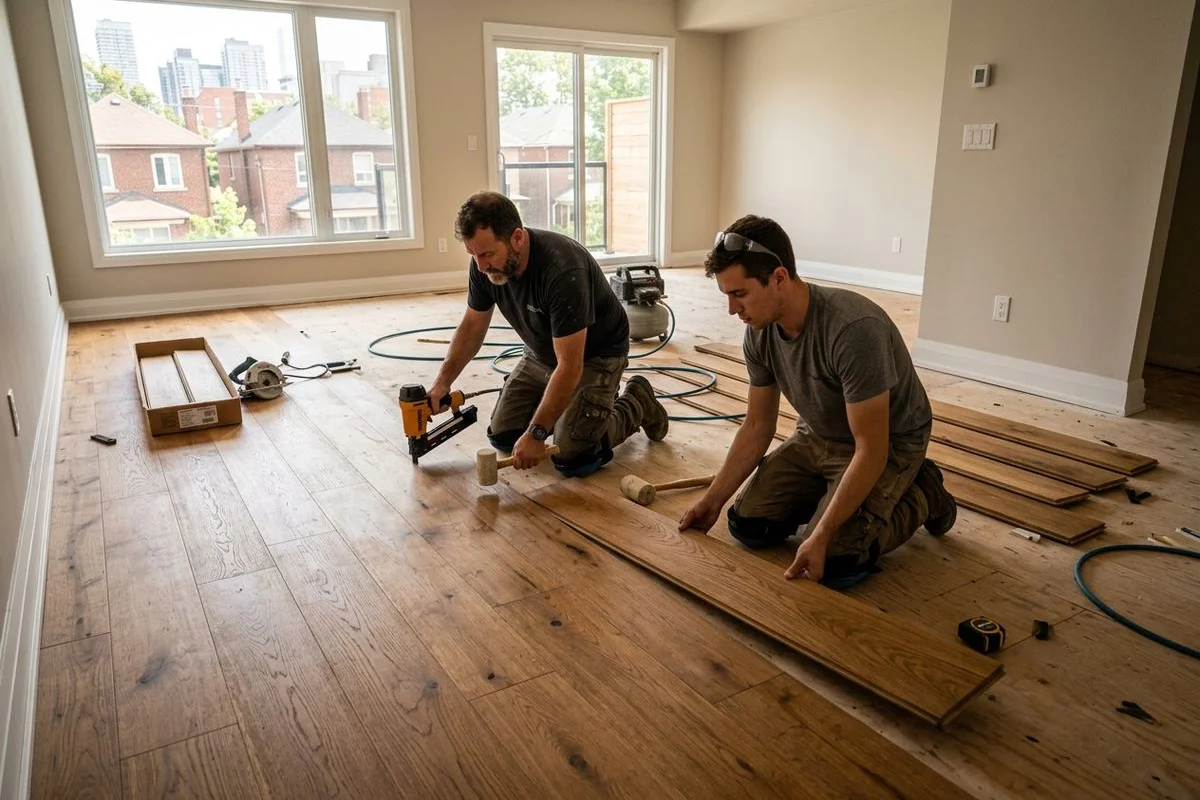
Coordinating a hardwood floor installation in Toronto requires understanding every phase of the project - not just the day the crew shows up with boards. From the moment material is delivered to the day you move furniture back, a complete site-finished hardwood installation typically takes 9-14 days. A pre-finished project on a small room can finish in as few as 4-5 days. Pattern work in a large room can push past 14 days.
The variation is large because five distinct phases each carry their own time requirements, and each one depends on conditions that can only be confirmed in person. Toronto Quality Wood Flooring provides a fixed-price written quote within 48 hours of a free in-home estimate, and that quote includes a calendar window for each phase based on the actual subfloor conditions we observe.
Phase 1 - Acclimation (2-5 days)
Acclimation is mandatory. It cannot be skipped or shortened without creating post-installation movement problems - the same gapping and cupping that Toronto homeowners call about six months after a rushed installation.
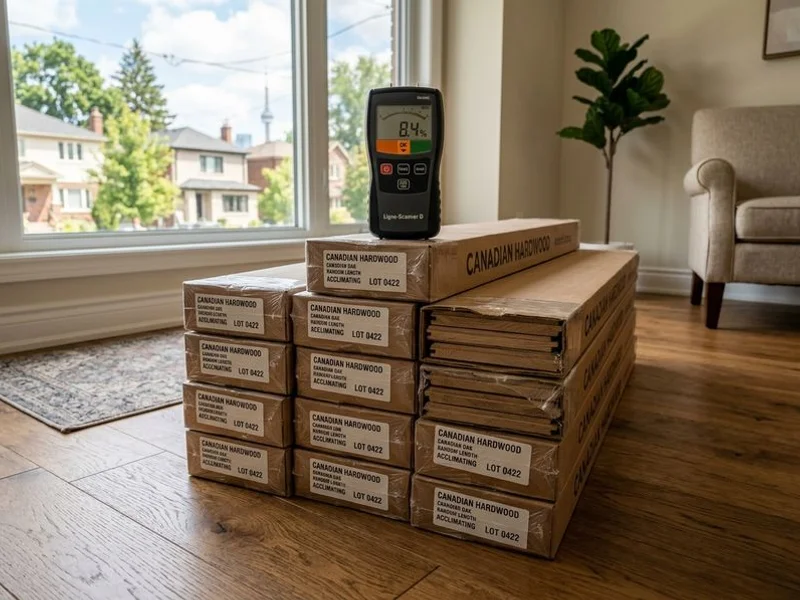
During acclimation, hardwood boards are brought into the installation room and left to equilibrate to the ambient temperature and relative humidity. The HVAC system must run at normal occupancy conditions throughout the acclimation period.
- Solid hardwood (all species, standard widths up to 4 inches): 3-5 days minimum
- Solid hardwood wide-plank (5 inches and above): 5-7 days
- Engineered hardwood (all widths): 2-3 days - cross-ply construction is more dimensionally stable and reaches equilibrium faster
The wood’s moisture content is checked with a calibrated meter (Wagner MMC220 or Tramex Encounter Plus) at the end of the acclimation period and cross-referenced against the subfloor. Solid hardwood and subfloor must read within 2-4% MC of each other before installation begins. If the gap is larger, acclimation continues until it narrows.
Phase 2 - Subfloor preparation (4-8 hours for standard, up to 2 days for problem subfloors)
A flat, structurally sound subfloor is the foundation of every successful installation. Toronto Quality Wood Flooring checks subfloor flatness to a tolerance of 3/16 inch over a 10-foot span before committing to an installation date. Problems discovered here determine how long Phase 2 takes.
A sound plywood subfloor in good condition requires 4-6 hours of preparation: belt sanding or grinding high spots, filling low spots with self-levelling compound, checking for squeaks (and screwing down loose panels), and rolling out any required vapour barrier.
Problem subfloors add time:
- Concrete slab with high spots: grinding with a floor grinder, 2-4 hours depending on area
- Concrete slab with low spots: self-levelling compound (Mapei Novoplan 2 Plus or similar) requires 24 hours to cure before hardwood can be installed over it
- Plywood with rot or water damage: board replacement and joist repair can add 1-2 days
- Heritage homes with original 1x6 diagonal subfloor planks: adding a layer of 3/8-inch plywood over the existing surface takes 4-6 hours and is often required for a stable nail-down substrate
For all concrete slab projects, ASTM F2170 relative humidity probes are installed and left in place for a minimum of 24 hours before adhesive is applied. This adds a day to Phase 2 but prevents adhesive bond failure from slab moisture.
Phase 3 - Installation (1-4 days depending on size and method)
Installation pace depends on the method, the pattern, and the room configuration. A skilled two-person crew works to these approximate benchmarks:
- Nail-down solid hardwood (straight lay): 400-600 sq ft per day
- Glue-down engineered hardwood (straight lay): 300-400 sq ft per day - the adhesive open time limits how much area can be spread at once, and a 24-hour cure window is required before foot traffic
- Herringbone or chevron pattern work: 150-200 sq ft per day - every piece is cut to a precise angle, alignment is checked at every row, and pattern work is inherently slower by design
See our companion guide on nail-down vs glue-down install for a full breakdown of method selection by subfloor type.
Phase 4 - Site finishing (0-5 days depending on finish type)
Pre-finished hardwood has no Phase 4. The factory finish is already on the board, and the installation is complete the moment the last transition strip is set. This is the fastest path from delivery to move-in, but the factory finish cannot be customised on-site and cannot be spot-repaired invisibly if damaged later.
Site-finished hardwood requires a multi-day sand-and-finish sequence after the raw boards are laid. Toronto Quality Wood Flooring follows this sequence for waterborne finishes (Bona Traffic HD is the default for occupied residential projects):
- Day 1: Rough sand with 36-40 grit. Removes mill marks, levels any minor height variation between boards. Dust is collected via dustless sanding system.
- Day 2: Medium sand with 60-80 grit. Stain is applied on Day 2 if a custom colour is specified. Stain must dry fully before finish coats begin - typically overnight.
- Day 3: First coat of Bona Traffic HD or equivalent waterborne finish. Dry time 2-3 hours, then light abrasion with 120-grit screen to denib the surface.
- Day 4: Second finish coat. Same abrasion process after drying.
- Day 5: Final coat. No abrasion. Light foot traffic (clean socks only) after 24 hours.
Oil-modified polyurethane follows a similar sequence but each coat requires 8-12 hours dry time rather than 2-3 hours, which can push the finish sequence to 7-8 days for a three-coat system. Waterborne finishes are strongly preferred for occupied Toronto homes because of lower VOC output and faster return-to-use times.
Rubio Monocoat 2C, a natural oil finish used on premium White Oak projects, is a two-component single-coat system that cures over 5-7 days. Light use is possible from Day 3 but full cure takes longer than waterborne.
Furniture return schedule for waterborne finish (Bona Traffic HD)
- 24 hours after final coat: sock-walk only, no shoes
- 48-72 hours: light furniture (chairs, small tables) with felt pads
- 7 days: normal furniture, appliances
- 14 days: area rugs - rugs placed before full cure trap moisture and can cause finish discolouration under the rug boundary
Phase 5 - Trim and transitions (4-6 hours)
Threshold cuts, T-mouldings, reducers, quarter-round, and stair nosings are the final phase. On a standard single-room project this is 3-4 hours of work. Whole-home installations with multiple doorway transitions, stair nosings on every tread, and complex threshold details at tile boundaries can take a full day.
Full project timelines at a glance
| Project Type | Acclimation | Subfloor Prep | Installation | Site Finishing | Total Window |
|---|---|---|---|---|---|
| Pre-finished, small room (400 sq ft) | 3 days | 0.5 day | 1 day | 0 (factory finish) | 4-5 days |
| Site-finished, medium room (800 sq ft) | 3-5 days | 0.5-1 day | 2 days | 4-5 days | 9-12 days |
| Herringbone pattern, large room (600 sq ft) | 3-5 days | 1 day | 3-4 days | 4-5 days | 11-15 days |
| Whole-home site-finished (1,200+ sq ft) | 5-7 days | 1-2 days | 3-4 days | 5-6 days | 14-19 days |
What extends timelines beyond the standard window
Several site conditions extend a hardwood installation timeline when discovered during the project. Reputable installers stop and fix these issues rather than installing over them - a longer project is always better than a floor that fails six months later.
- Major subfloor remediation: Rot, water damage, or significant height variation discovered after tear-out adds 1-2 days for repairs plus drying time for compounds
- Custom stain matching: Stain samples are applied to actual flooring material and allowed to dry before approval. If multiple rounds of samples are needed, add 1-2 days per round
- High subfloor moisture readings: A plywood subfloor reading above 12% MC or a concrete slab F2170 reading above the adhesive threshold requires drying time and potentially a moisture mitigation system before installation can proceed
- Complex pattern work: Herringbone and chevron installations run at 1.5-2x the labour time of straight-lay work
- Stair finishing: Each stair tread and riser is individually measured, cut, and fitted. Expect 45-60 minutes per tread for installation, plus the full finishing sequence
If you are weighing whether to refinish existing floors rather than install new hardwood, see our guide on how long refinishing takes for a comparison of both project types.
Ready to schedule your installation?
Toronto Quality Wood Flooring provides a free in-home estimate that covers subfloor inspection, acclimation planning, and method selection. You receive a written fixed-price quote within 48 hours that includes a realistic calendar window for every phase - so you can coordinate painters, cabinetry crews, and move-in dates with confidence. Visit our homepage to book your estimate.