Why Toronto’s climate is harder on hardwood than most North American cities
Wood is hygroscopic. It absorbs moisture from the surrounding air when humidity rises and releases moisture when humidity drops. This dimensional movement is built into the material and cannot be eliminated - only managed. The question for Toronto homeowners is not whether their hardwood floor will move, but whether the seasonal swing in their home is large enough to make that movement visible and damaging.
Toronto’s climate makes that question particularly important. A forced-air heated Toronto home in January commonly sits at 15-25% relative humidity (RH) without active humidification. Outdoor temperatures dropping to -20°C pull so much moisture out of the air that even well-sealed homes become extremely dry once the furnace runs continuously. In summer, the same house without air conditioning can reach 65-85% RH in below-grade spaces and ground-floor rooms with poor ventilation.
That swing - potentially 60 percentage points across the year - is more severe than what homeowners in Dallas, Phoenix, or even most US East Coast cities experience. It is why Toronto Quality Wood Flooring considers humidity control as important as any product or installation decision.
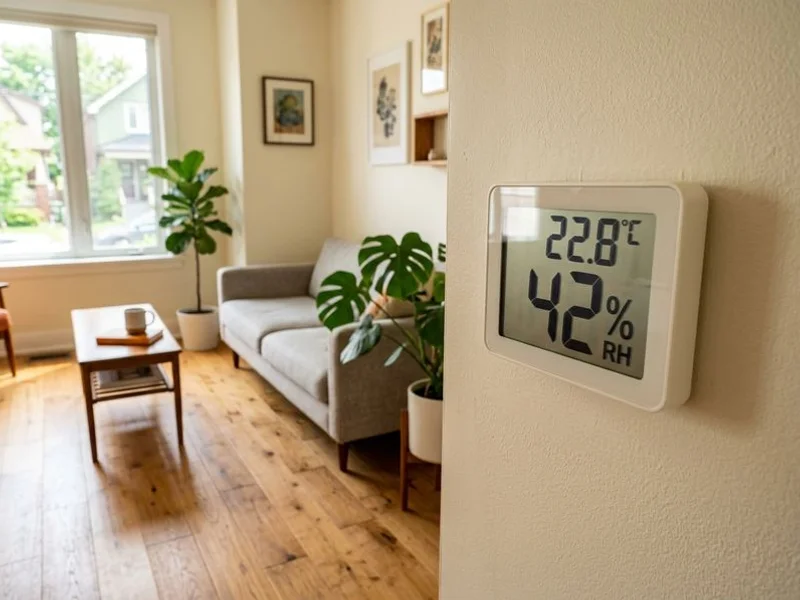
The National Wood Flooring Association (NWFA) recommends 35-55% RH year-round for installed hardwood. The practical target for Toronto homes is 40-50% RH, which requires active management in both summer and winter.
How wood moves in response to humidity - the numbers
Wood expands and contracts primarily across the grain (the width of the plank), not along its length. The amount of movement depends on the species and the size of the humidity change.
As a reference point: Red Oak expands roughly 2% across its width for every 4% change in moisture content. A 5-inch Red Oak plank moving through a full Toronto seasonal swing - from dry January conditions at roughly 6% wood moisture content (MC) to humid August conditions at roughly 11% MC - can move approximately 1/8 to 3/16 inch across its width. Multiply that across a 12-foot room with 28-30 boards side by side and the cumulative movement is significant.
Wider planks move more in absolute terms than narrow strip flooring. A 7-inch White Oak wide-plank floor in a poorly humidified North York home will show far more visible winter gapping than a 2.25-inch strip floor in the same conditions.
| Season | Typical Toronto RH (uncontrolled) | Approximate Wood MC Equivalent | Risk to Hardwood | Mitigation Required |
|---|---|---|---|---|
| Deep winter (Jan-Feb) | 15-25% RH | 4-6% MC | Gapping between boards, checking along grain | Whole-home humidifier at 40% RH |
| Early spring (Mar-Apr) | 30-45% RH | 7-8% MC | Boards expanding - gaps closing | Monitor, humidifier still beneficial |
| Summer (Jun-Aug) | 55-75% RH (above grade); 70-85% below grade | 10-13% MC | Cupping (edges rise), surface pressure | Central AC above grade; dehumidifier below grade |
| Autumn (Sep-Nov) | 40-55% RH | 8-9% MC | Boards contracting again - monitor for permanent gaps | Begin humidification before furnace season |
Gapping in winter - what is normal and what is a problem
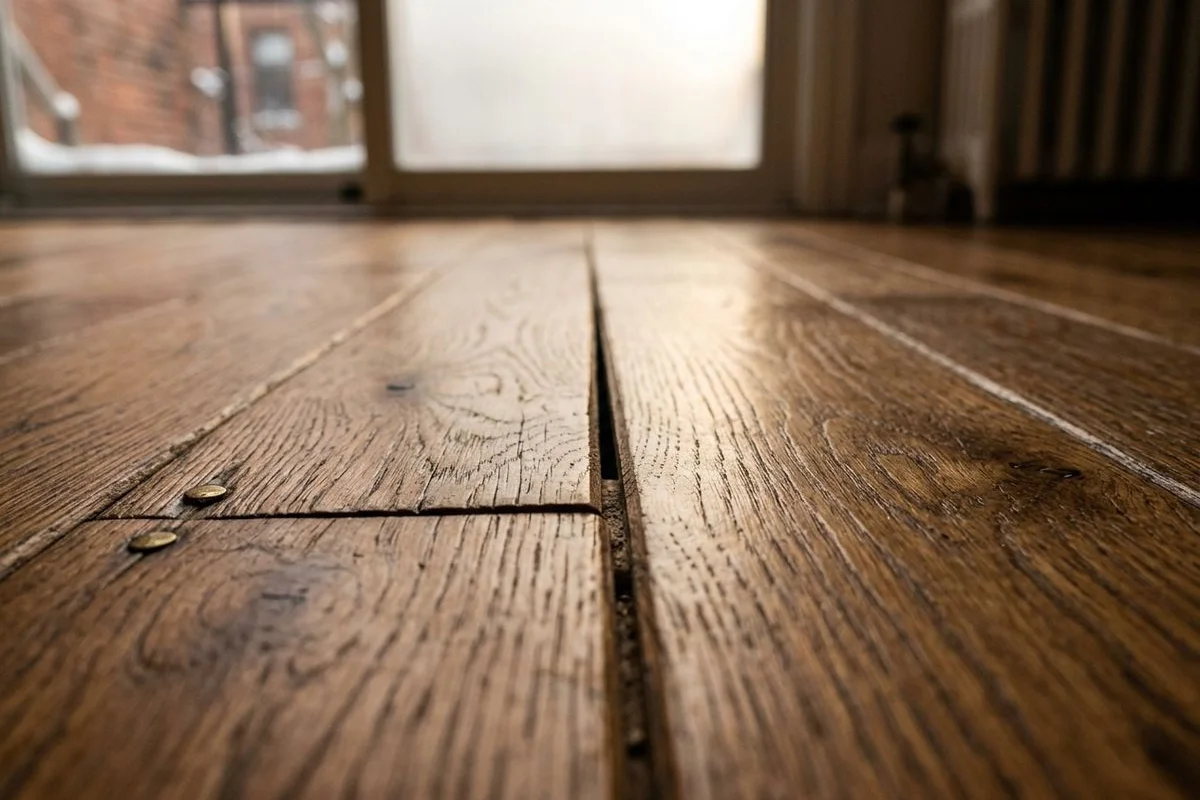
Narrow gaps opening between boards during January and February are a normal part of hardwood’s seasonal behaviour in a Toronto home. A gap of under 1mm that closes by late spring or early summer is the floor breathing in response to dry winter air. This is expected, not a defect.
The gaps become a problem in two scenarios:
First, when gaps exceed 1mm and fail to close fully by August. This indicates the floor spent too many consecutive winters at very low RH - likely below 30% - and the boards contracted so significantly and repeatedly that the tongue-and-groove joints permanently loosened. The floor is now structurally wider in total than its original installation width, and the boards cannot fully close back up.
Second, when gaps appear that are large enough to hold a penny on edge (roughly 2-3mm). This level of gapping visible in summer means either the boards were installed at too-high moisture content and shrank dramatically as they dried to the home’s ambient conditions, or the home drops below 25% RH in winter and the wood is experiencing extreme stress.
Root cause in most Toronto gapping cases: the house is too dry in winter. A whole-home humidifier installed on the furnace, set to 40% RH and verified with an independent wall-mounted hygrometer, resolves winter gapping in the majority of cases.
Cupping in summer - causes and what not to do
Cupping is the opposite of gapping. The edges of each board rise higher than the centre, giving the floor a wavy, corrugated surface. Run your hand across a cupped floor and you feel the ridges between boards rather than a flat surface.
Cupping happens when the bottom of the board absorbs more moisture than the top. The bottom expands and pushes the edges upward. The two most common causes in Toronto homes are:
- Moisture rising from a subfloor or below-grade slab that was not properly dried and tested before installation
- A home that is not air-conditioned in summer, allowing above-grade humidity to climb into the 65-75% RH range
The critical rule with a cupped floor: never sand it flat while it is still cupped. Sanding a cupped floor removes material from the raised edges and thins them permanently. When the floor dries out and flattens, the sanded edges are now lower than the board centres - the result is called crowning, and it is worse than the original cupping. The correct approach is to identify and eliminate the moisture source, allow the floor to return to its equilibrium MC, verify with a moisture meter like the Wagner MMC220 or Tramex Encounter Plus, and only then sand if the surface has not returned to flat on its own.
If the cupping is mild and caught early, and the moisture source is removed, many floors will flatten themselves without any sanding at all.
Pre-installation moisture testing - why it prevents most problems
The single most effective way to prevent Toronto humidity hardwood floor gapping is rigorous moisture testing before installation begins. Installing hardwood over a subfloor that is wetter than the wood, or into a house that is not yet at its finished occupied RH, guarantees movement problems after the fact.
Toronto Quality Wood Flooring uses two instruments for pre-installation moisture verification:
- Wagner MMC220 or Tramex Encounter Plus - non-invasive pinless meters that scan the subfloor and existing hardwood without leaving marks. Used for rapid screening of plywood and existing wood subfloors.
- ASTM F2170 RH in-situ probes - required for all concrete slab installations. A hole is drilled 40% of the way through the slab depth, a sleeve is inserted, and a calibrated RH sensor is left in place for a minimum of 24 hours. This measures the actual vapour emission from within the slab, not just the surface. The ASTM F2170 standard is the industry benchmark because surface readings consistently underestimate what is happening deeper in the concrete.
For solid hardwood over plywood, the subfloor MC and the hardwood MC must be within 2-4% of each other before installation proceeds. For concrete slab installs, the F2170 reading must fall within the adhesive manufacturer’s specified RH limit before glue-down begins.
Acclimation - the required step before installation
Acclimation is the period during which hardwood boards equilibrate to the temperature and humidity conditions of the room where they will be installed. The boards are unpacked (or loosely stacked with spacers for air circulation) in the installation room with the HVAC running at normal occupancy conditions.
- Solid hardwood in widths up to 4 inches: 3-5 days minimum
- Solid hardwood in widths 5 inches and above: 5-7 days minimum
- Engineered hardwood: 2-3 days (cross-ply construction is dimensionally more stable)
Skipping acclimation is one of the leading causes of post-installation movement in Toronto homes. Wood delivered from a warehouse in February may arrive at 4-5% MC. If installed immediately into a home running at normal conditions - say 45% RH and 21°C - the boards will absorb moisture and expand after installation, causing buckling and joint stress. Proper acclimation eliminates this risk entirely.
Mitigation systems that work in Toronto homes
Controlling indoor RH year-round requires different tools in each season.
Winter humidification: A whole-home steam or flow-through humidifier installed on the furnace plenum is the most effective solution. A properly sized unit for a Toronto home typically costs $600-1,200 installed and can maintain 40% RH even during -20°C cold snaps. Set it and verify with an independent hygrometer - do not rely solely on the humidifier’s built-in display, which reads conditions at the unit rather than at floor level.
Portable evaporative humidifiers are a lower-cost alternative but require daily refilling and careful placement. Never place a portable steam humidifier directly next to a hardwood floor - the concentrated moisture output causes local cupping within a few feet of the unit.
Summer dehumidification: Central air conditioning is effective above grade and handles most main-floor and upper-level humidity control during Toronto summers. Below grade - finished basements in particular - requires a dedicated high-capacity dehumidifier. A 70-pint or larger unit set to 50% RH provides reliable protection in a finished basement throughout the humid season.
Rosedale and Forest Hill homes with unfinished crawl spaces or stone foundations face additional below-grade moisture challenges that a standard basement dehumidifier does not address. These situations require a site-specific assessment.
When to call for professional assessment
If you are seeing gaps that do not close in summer, cupping that has persisted through two dry seasons, or finish that is separating from the board surface, the floor needs a professional moisture investigation before any repairs are attempted. Sanding, refinishing, or gap-filling without identifying the moisture source produces temporary results at best.
Toronto Quality Wood Flooring carries ASTM F2170 probes and calibrated moisture meters on every service call. A full moisture investigation - subfloor scan, ambient RH measurement, and vapour source assessment - takes approximately 45 minutes and gives a clear picture of what the floor is experiencing and why.
Explore our guide on fixing cupping and crowning in hardwood floors for the full remediation process, or visit our homepage for a free in-home estimate and 48-hour fixed-price quote on any hardwood flooring repair or new installation.