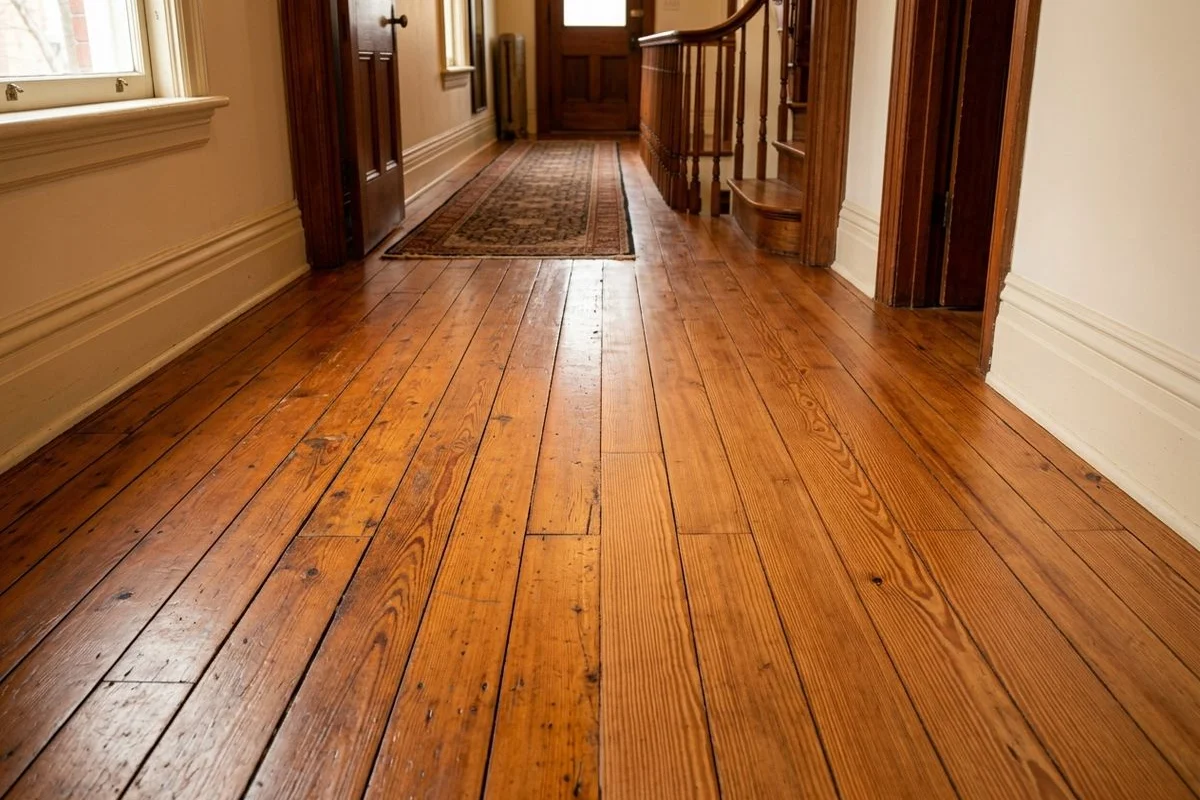
The core question every heritage floor assessment starts with
Every heritage floor that comes in for assessment at Toronto Quality Wood Flooring gets an honest board-by-board evaluation before any recommendation is made. The objective is straightforward: save as many original boards as possible, replace only those that cannot be saved.
This is not a philosophical position - it is the only approach that produces an authentic result. Original pre-1940 boards in a Cabbagetown row house or a Rosedale Victorian have grain density, UV oxidation, and surface character that cannot be reproduced with new lumber. Every original board that is replaced is irreplaceable material that leaves the project. The goal is to minimise that loss while still producing a structurally sound, refinishable floor.
The complete framework for this type of work sits in the historic wood floor restoration hub. This guide focuses specifically on the diagnostic process and the decision logic that determines which boards stay and which go.
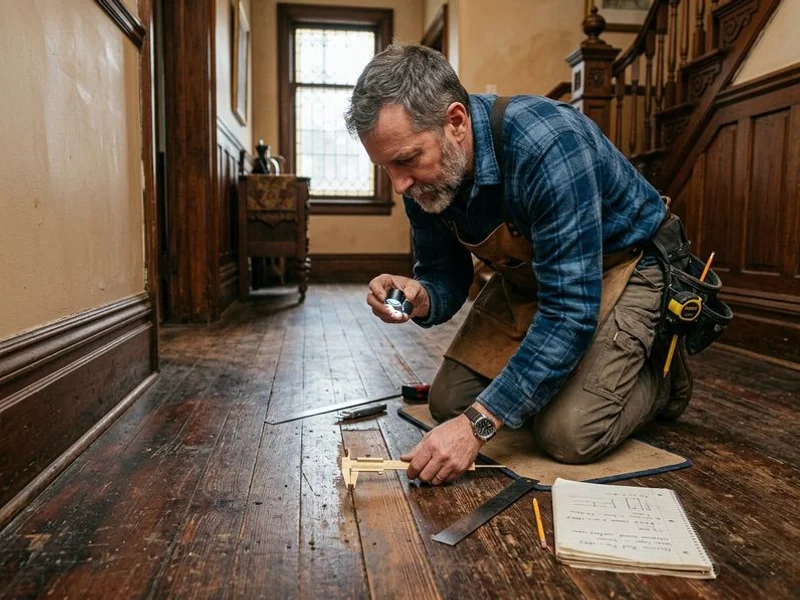
The diagnostic process - what gets measured and why
Wear-layer measurement
The most important single number in a heritage floor assessment is the wear layer remaining above the tongue. Lift a register cutout or threshold board and measure the wood above the tongue groove with a micrometer or digital caliper. Pre-1940 floors were typically installed at 3/4” (19mm) total thickness. If a floor has been refinished two or three times, some of that thickness has been removed.
The National Wood Flooring Association (NWFA) sets 3mm above the tongue as the minimum safe threshold for sanding. Below 3mm, sanding risks exposing the tongue groove and producing splinters and structural failure at the board edges. Toronto Quality Wood Flooring uses this 3mm threshold consistently. Most pre-1940 Toronto floors we assess - Red Pine in Cabbagetown, Red Oak in the Annex, quartersawn White Oak in South Rosedale - still have 5mm+ above the tongue because old-growth lumber at original thickness is generous.
Tap test for structural soundness
Walking the floor and listening is the second stage of every assessment. A firm, solid sound indicates good adhesion and structural integrity. Hollow sections indicate adhesion failure, subfloor delamination, or a gap developing between the board and the subfloor. Soft spots indicate rot or delamination at the board core. Spring - a floor that bounces underfoot - may indicate a joist or blocking issue beneath the floor rather than a board-level problem.
Distinguishing board-level problems from subfloor and joist problems matters because the repair approach differs completely. A board that sounds hollow due to adhesion failure may be perfectly sound wood that needs to be re-secured. A soft spot caused by rot needs the board removed and replaced.
Moisture reading
A Wagner MMC220 pin moisture meter is used on every suspect board before a replacement decision is made. Active moisture above 12% MC in the floor wood indicates a moisture source that has not been resolved. Sanding a floor with active moisture issues before the source is addressed will result in renewed cupping, finish failure, and the same damage recurring within a year.
The moisture source - typically a plumbing penetration, a basement humidity issue, or a bathroom adjacency - must be addressed before restoration work begins. For boards showing active moisture above 12% MC, the correct sequence is: resolve the moisture source, allow the floor to dry to below 10% MC (typically 4-12 weeks depending on severity), then reassess.
Visual inspection categories
Surface checking - shallow cracks running along the grain direction of a board - is common in pre-1940 floors and is not typically a reason for board replacement. These cracks are a product of the wood’s seasonal movement over decades and can be filled with colour-matched wood filler and sanded flat.
End splits - cracks at the board ends running more than 30% of the board length - indicate significant stress at that point and may require replacement depending on location and severity.
Blue stain - a blue-grey discolouration in the wood fibre - indicates past fungal activity from moisture exposure. The presence of blue stain does not necessarily mean the board is structurally compromised, but the moisture history should be noted and the board checked for softness.
Dark iron staining around original nail holes is normal in pre-1940 floors and is produced by the chemical reaction between iron fasteners and the tannins in the wood. This is a character element, not a defect. It can be lightened with oxalic acid treatment if desired.
When original boards can be restored
A board qualifies for restoration rather than replacement when all of the following conditions are met:
- Sound structure with no rot, no active moisture above 12% MC, no fractured tongue-and-groove
- Wear layer of 4mm+ above the tongue (3mm minimum per NWFA, 4mm recommended for pre-1940 softwood that sands faster than hardwood)
- Surface damage limited to checking, surface scratches, or staining that can be addressed with filling and sanding
- Original character - face-nail pattern, hand-scrape texture, surface checking pattern - intact and worth preserving
Hand-scrape damage and deep surface scratches in otherwise sound boards: fill with colour-matched wood filler, sand, apply period-correct finish. These boards stay.
Minor cupping under 2mm (boards slightly higher at the edges than the centre): this is a moisture response. Identify and resolve the moisture source, allow the floor to return to flat - typically 4-8 weeks - then sand. These boards usually stay.
Localised staining from water, pet urine, or historic finish discolouration: oxalic acid bleach and peroxide treatment before refinishing can address most localised staining without board replacement. Severe staining that has penetrated through the full depth of the wear layer may require replacement.
Previous wrong-species patches installed by prior owners: these are replaced, but their removal frees up an opportunity to use properly matched reclaimed material and restore visual consistency to the floor.
When replacement is necessary
Some board conditions cannot be remediated through surface treatment. Replacement is required when:
- Rot or insect damage: soft spots, powdery wood fibre, frass (insect debris). The board is structurally compromised and cannot support foot traffic safely.
- Cupping over 4mm that has not returned to flat after 3+ months of proper humidity control (45-55% RH maintained consistently). Permanent cupping at this scale indicates irreversible cell structure damage from sustained moisture exposure.
- End splits running more than 30% of board length: the board will continue to split under seasonal movement.
- Wear layer under 2mm: the board cannot take another sanding. Any attempt to resurface it will expose the tongue groove.
- Board delamination: engineered floor failure or adhesive breakdown in a laminated board. Not applicable to original solid boards but relevant when prior owners have introduced engineered panels as repairs.
- Tongue-and-groove fracture: a board with a broken tongue or split groove cannot lock securely into its neighbours and will move, squeak, and eventually fail.
Reclaimed board sourcing - what to specify and how long it takes
When replacement is necessary, reclaimed era-matched stock is the only option that produces an invisible repair. New lumber of the same species is not equivalent.
| Feature | Old-growth reclaimed (pre-1920) | Modern new-growth lumber |
|---|---|---|
| Growth-ring density | 12-20 rings per inch | 3-7 rings per inch |
| Colour and oxidation | Deep amber from decades of air exposure | Pale, uniform, no oxidation |
| Milling character | Period surface marks visible | Flat, smooth from industrial planer |
| Dimensional stability | Highly stable - wood has already moved through decades of cycles | More prone to cupping and movement |
| Cost | $4-8/sq ft premium over new stock | Standard lumber pricing |
Sources for reclaimed era-matched stock in Ontario include architectural salvage yards, heritage deconstruction projects, church demolitions, school gymnasium tearouts (for wide-plank material), and old barn beams milled down for wide-plank restoration.
When specifying reclaimed stock for a heritage floor, the following must be matched:
- Species (Red Pine vs Red Oak vs quartersawn White Oak vs Douglas Fir)
- Face width (2.25”, 3”, 3.5”, 4” - Victorian floors were not standardised)
- Grain pattern (flat-sawn vs quartersawn - visually distinct at floor level, especially in raking light)
- Approximate age and oxidation level
Lead time for custom matching is typically 2-6 weeks. This is factored into the project timeline at the assessment stage. Clients who are working to a deadline should confirm reclaimed sourcing availability before finalising a project start date.
Board condition reference guide
| Board condition | Restoration viable? | Approach | Cost estimate |
|---|---|---|---|
| Sound, 5mm+ wear layer, surface scratches | Yes | Sand, fill, period-correct finish | Included in base refinish rate |
| Sound, 3-4mm wear layer, minor staining | Yes - one more sanding | Oxalic acid treatment + sand + finish | Included in base rate + $1-2/sq ft stain treatment |
| Minor cupping under 2mm, moisture resolved | Yes - after drying | Wait for flat, then sand | Included in base rate |
| Surface checking, colour-matched filler | Yes | Fill, sand, finish | Included in base rate |
| Wrong-species prior patch | Replace the patch | Remove, source reclaimed match, reinstall | $150-400 per board |
| Rot or insect damage | No | Remove, source reclaimed match, reinstall | $150-400 per board + reclaimed material |
| Wear layer under 2mm | No | Replace with reclaimed era-match | $150-400 per board + reclaimed material |
| Cupping over 4mm, irreversible | No | Replace with reclaimed era-match | $150-400 per board + reclaimed material |
For a full breakdown of what heritage restoration costs by scope, including reclaimed sourcing, hand-scrape texture work, and period-correct finish premiums, see the guide on heritage restoration cost.
Next step
Toronto Quality Wood Flooring provides a free in-home estimate and a 48-hour fixed-price written quote for all heritage restoration projects. The diagnostic visit includes wear-layer measurement, moisture reading, board-by-board condition assessment, reclaimed sourcing feasibility review, and heritage compliance check for designated properties. Contact us to schedule your assessment.