What historic wood floor restoration actually means
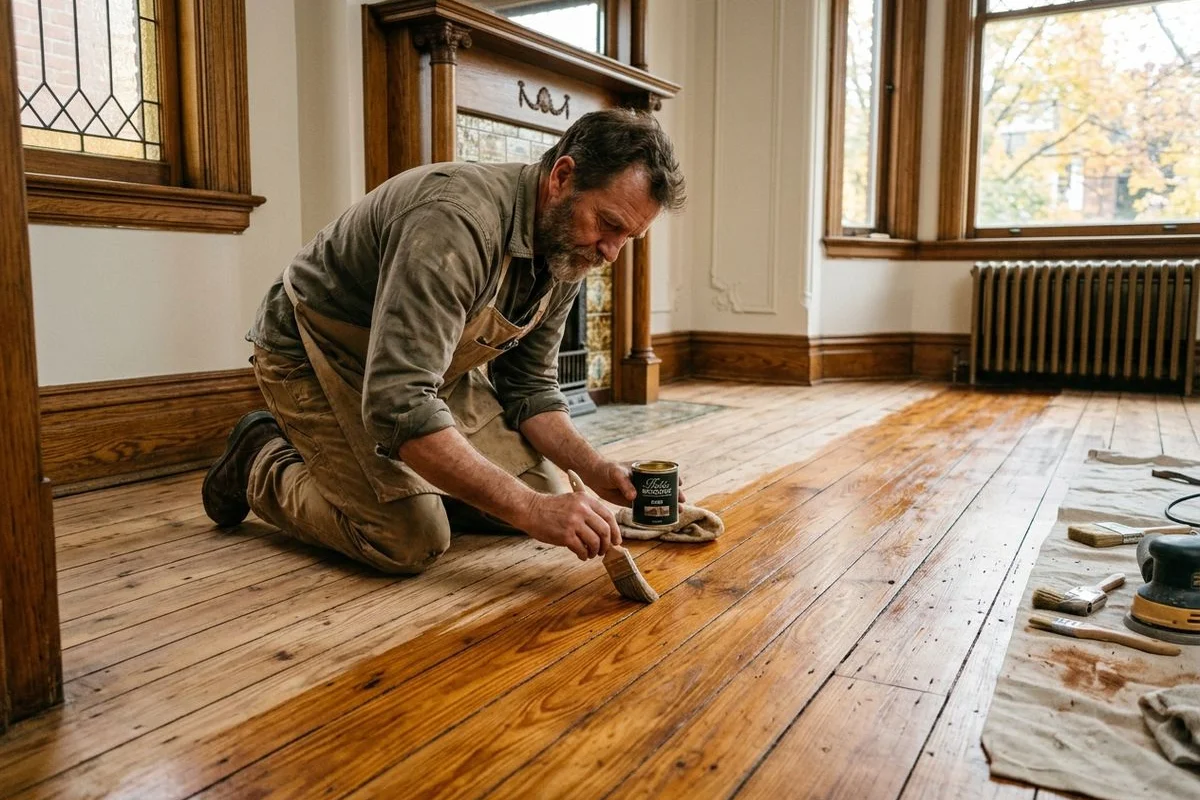
Historic wood floor restoration is the process of returning a pre-1940s wood floor to its period appearance and structural integrity using techniques and materials appropriate to the floor’s era - not simply sanding and recoating the surface.
This distinction matters enormously in Toronto’s heritage neighbourhoods. In Rosedale, Cabbagetown, the Annex, Forest Hill, and Riverdale, the majority of pre-war homes contain original floor boards that cannot be replicated with modern lumber. Aggressive modern sanding strips away hand-scraped textures, destroys original face-nail patterns, and leaves a flat, characterless surface that reads as fake to anyone who knows what they are looking at.
Standard historic wood floor restoration covers the full scope of this work - from board-by-board assessment through to period-correct finishing. This guide explains what separates restoration from ordinary refinishing, and what each stage of a genuine restoration project involves.
Restoration vs refinishing - the core difference
The terms get used interchangeably, but they describe completely different scopes of work.
Standard refinishing involves sanding the existing boards flat using a drum sander, applying new finish coats, and calling the job done. No board replacement occurs. The finish applied is almost always a modern waterborne or oil-modified polyurethane at gloss or semi-gloss sheen. Refinishing costs $3-8 per square foot and takes 4-5 days. It is appropriate for post-1940 hardwood in sound condition where the goal is a clean, renewed surface - not a period-accurate one.
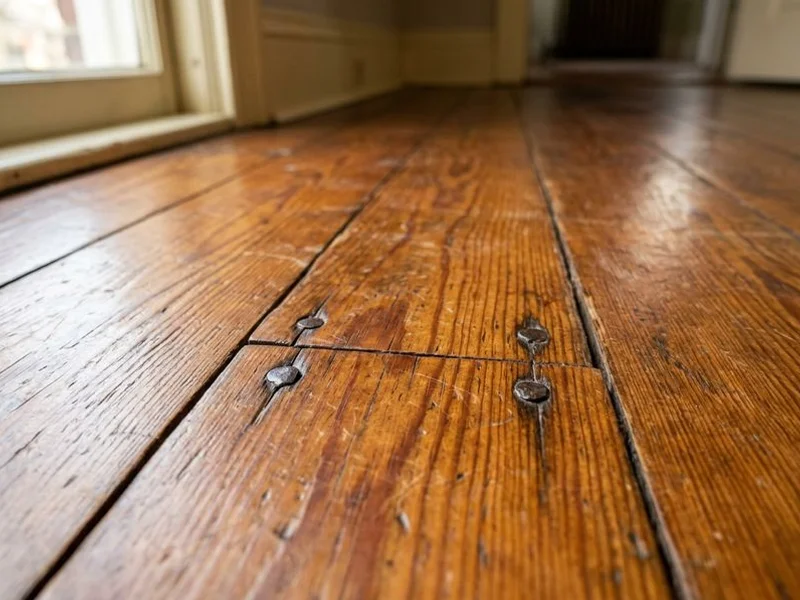
Historic restoration treats each board individually. The process assesses which boards are sound enough to preserve, which need repair, and which need full replacement with era-matched reclaimed stock. Texture replication - hand-scraping, wire-brushing, saw-mark preservation - is carried out on any new or repaired boards before installation. The finish is period-correct: typically a flat or matte hardwax oil such as Rubio Monocoat 2C, not high-gloss polyurethane. Face-nail patterns visible on pre-1940 softwood floors are preserved, not filled. Restoration costs $8-18 per square foot and takes 7-21 days depending on scope.
The table below summarises where the two approaches diverge:
| Aspect | Standard Refinishing | Historic Restoration |
|---|---|---|
| Board replacement | No | Yes - era-matched reclaimed stock |
| Texture replication | No | Yes - hand-scrape, wire-brush, saw-mark |
| Finish type | Modern polyurethane | Period-correct hardwax oil |
| Face nails | Filled or hidden | Preserved |
| Timeline | 4-5 days | 7-21 days depending on scope |
| Cost | $3-8/sq ft | $8-18/sq ft+ |
What a restoration project involves stage by stage
Stage 1 - Board-by-board assessment
Every restoration begins with a thorough diagnostic before any sanding equipment is brought in. A register cutout or threshold is lifted to expose the board cross-section. The remaining wear layer above the tongue is measured with a micrometer - the National Wood Flooring Association (NWFA) sets 3mm as the minimum safe threshold for re-sanding.
Beyond thickness, the assessment documents: species and cut (flat-sawn Red Pine vs quartersawn White Oak vs Douglas Fir behave very differently under restoration conditions), original face-nail patterns, surface texture characteristics such as shallow hand-scrape marks or wire-brush striations, and any areas of rot, cupping, or delamination.
This stage cannot be skipped or shortened. Pre-1940 Toronto floors in Rosedale Victorians and Annex semi-detached homes vary enormously from room to room - boards near old radiator locations may have active moisture damage while boards in the same room under original cabinetry are perfectly preserved.
Stage 2 - Reclaimed board sourcing
Boards that cannot be saved are replaced with era-matched reclaimed stock, not new lumber. This is non-negotiable for authentic restoration. Modern Red Pine milled today has growth rings at roughly 4-6 per inch. Old-growth Red Pine from a pre-1900 Ontario building will have 12-20 growth rings per inch - a fundamentally denser, harder, differently coloured material. The UV oxidation in a 100-year-old board creates amber undertones that new lumber cannot replicate regardless of stain.
Reclaimed board sourcing draws on Ontario salvage networks: architectural salvage yards, heritage deconstruction projects, church demolitions, and school gymnasium tearouts for wider plank material. Species and grain pattern must be specified - flat-sawn vs quartersawn matters visually at floor level, particularly in raking light. Lead time for custom matching is typically 2-6 weeks, which is factored into the project schedule.
Stage 3 - Surface texture replication
Pre-1940 floors were not flat. They show the marks of the tools and methods used to install and finish them. Hand-scraped floors have shallow curved knife marks across the face. Wire-brushed floors have open grain with the softer wood fibres removed and the harder rings standing proud. Some Douglas Fir and Red Pine floors in Cabbagetown and Leslieville show circular saw-cut marks from original milling.
Any reclaimed board introduced to the floor needs to receive matching texture treatment before it is installed. An unmatched board - even if the species and colour are correct - will stand out under the flat raking light of a long hallway.
Stage 4 - Period-correct finish selection
Pre-1940 floors were finished with linseed oil, shellac, wax, or left with minimal surface coating. They were not coated with high-gloss polyurethane. Applying a modern semi-gloss polyurethane to a Victorian Red Pine floor produces a finish that looks wrong - too plastic, too reflective, too uniform - regardless of how well the sanding was executed.
For period-correct results, Rubio Monocoat 2C hardwax oil is the standard choice. It penetrates the wood fibre rather than forming a surface film, producing a flat oiled sheen consistent with pre-1940 finishes. Bona DriFast stain in amber or walnut tones is used where the original floor colour needs matching - it replicates the UV oxidation of aged original finish without requiring decades of weathering.
Stage 5 - Face-nail pattern preservation
Pre-1940 softwood plank floors - Red Pine in Cabbagetown row houses, Annex semi-detached homes, Riverdale Victorians - were face-nailed. The fasteners were driven through the board face rather than through the tongue and groove. Square-cut nails from this era leave rectangular impressions in the wood surface.
These patterns are part of the floor’s character and historical record. Authentic restoration preserves them. Standard refinishing fills them with wood putty and sands them flush, which erases a visible marker of the floor’s age and method of construction.
Which Toronto homes need historic restoration
The neighbourhoods where heritage restoration is most relevant follow the pre-1940 building pattern closely:
- Cabbagetown (Parliament St corridor): 1875-1900 Victorian terraces, narrow Red Pine plank floors, visible face-nail patterns
- South Rosedale (Crescent Rd, Elm Ave): 1890-1915 mixed stock, quartersawn White Oak in better rooms, Red Pine in secondary spaces
- The Annex (Major St, Brunswick Ave, Howland Ave): 1895-1910 late-Victorian and early Edwardian, mixed Red Pine and Red Oak
- Forest Hill (Spadina Rd): 1920-1938 Tudor and Georgian Revival, predominantly Red Oak and Maple
- Leslieville and Riverdale (Broadview/Logan corridor): 1880-1910 worker cottages and semi-detached, Red Pine throughout
For designated properties on the Toronto Heritage Register, work must comply with the property’s heritage designation. Toronto Quality Wood Flooring coordinates with Toronto Heritage Preservation Services in advance for these projects, following conservation guidelines on original-board treatment, finish selection, and reclaimed sourcing.
What to look for before calling
If you are assessing a pre-1940 Toronto home before booking a restoration consultation, look for these indicators that the original floor is still restorable:
- Visible face-nail heads on the board surface (pre-1900 softwood floors)
- Narrow board widths of 2.25”-4” (original strip installation, not modern 5”+ wide plank)
- Flat or matte existing finish sheen (original oil or shellac, not polyurethane)
- Amber or warm honey colour in protected areas under rugs or cabinetry
- Circular or hand-scrape marks visible in raking light
Floors that have already been aggressively sanded multiple times may have insufficient wear layer remaining - under 2mm above the tongue - for safe restoration. This is confirmed during the in-home diagnostic stage.
For a neighbourhood-specific look at what Victorian-era restoration involves in Cabbagetown, Rosedale, and the Annex, see the companion guide on restoring Victorian hardwood floors.
Next step
Toronto Quality Wood Flooring provides a free in-home estimate and a 48-hour fixed-price written quote for all heritage restoration projects. The diagnostic visit includes species identification, wear-layer measurement, board-by-board assessment, and heritage compliance review for designated properties. Contact us to schedule your assessment.