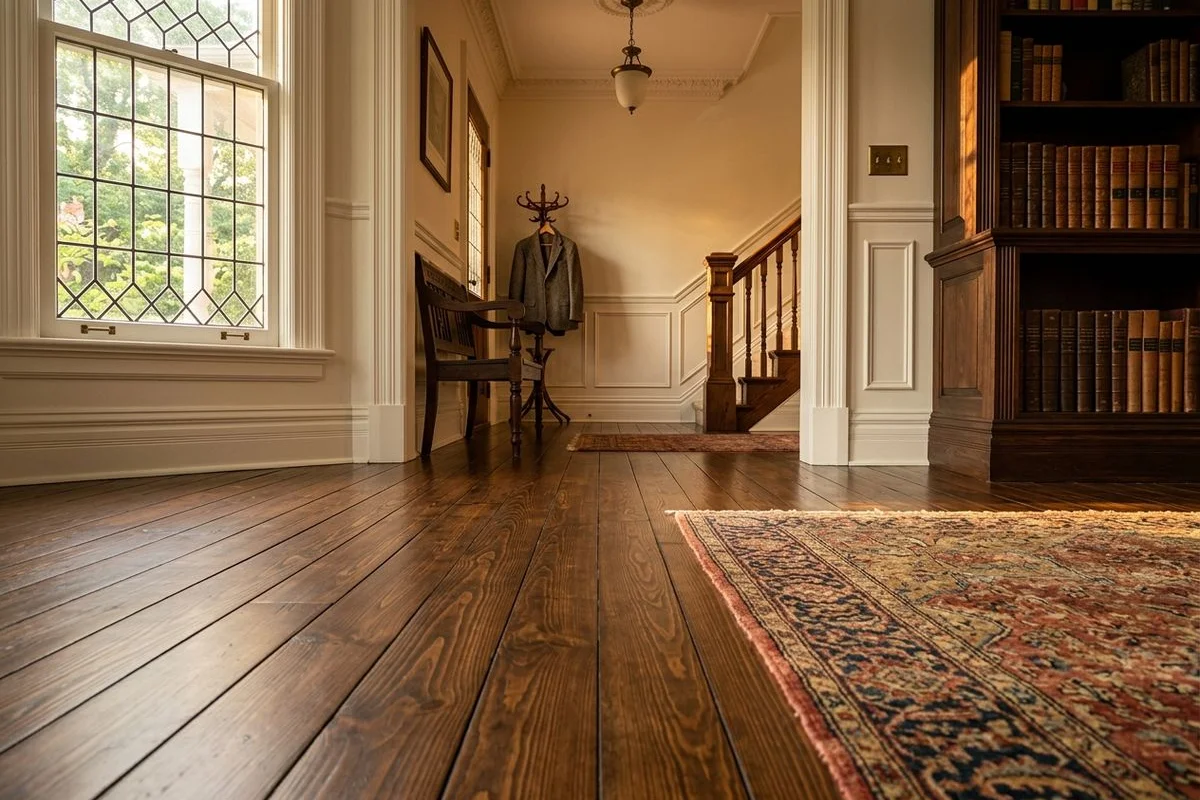
Toronto’s Victorian housing stock runs from roughly 1870 through to the Edwardian period ending around 1914. The floors in these homes - narrow-board Red Pine in Cabbagetown, quartersawn White Oak in South Rosedale, mixed species in the Annex and Riverdale - were installed when the houses were built and have been part of those rooms ever since. They cannot be replicated with modern lumber. The materials, the grain density, the UV oxidation, and the character marks accumulated over 100-plus years are unique to these original boards.
Standard refinishing treats them the same way it treats a 1995 Red Oak floor in a Scarborough subdivision: sand flat, apply polyurethane, walk out. The result is a floor that has lost its original surface character and gained a finish sheen that belongs to a completely different era. Toronto Quality Wood Flooring approaches Victorian and Edwardian floors differently from the outset, working through the complete assessment and restoration framework described in the historic wood floor restoration hub.
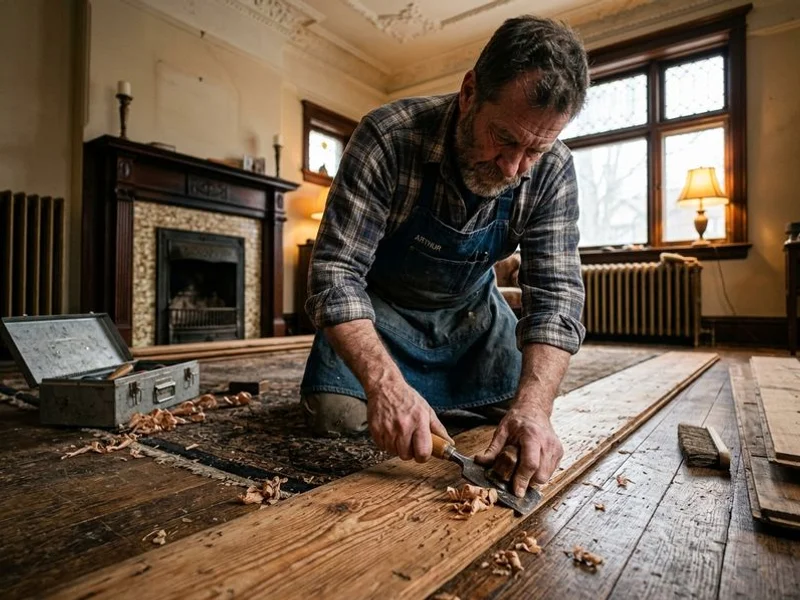
Victorian Toronto housing stock and what to expect by neighbourhood
The Victorian period in Toronto produced distinct flooring profiles by neighbourhood and decade. Knowing what your house is likely to contain before the diagnostic visit helps you understand what the restoration will involve.
| Neighbourhood | Typical era | Common species | Era-correct finish | Heritage register? |
|---|---|---|---|---|
| Cabbagetown (Parliament St corridor) | 1875-1900 | Narrow Red Pine 2.5”-4” face | Rubio Monocoat 2C Aged or Pure | Many properties listed |
| South Rosedale (Crescent Rd, Elm Ave) | 1890-1915 | Quartersawn White Oak + Red Pine secondary | Bona DriFast amber stain + matte finish | Yes - Toronto Heritage listed |
| The Annex (Major St, Brunswick Ave) | 1895-1910 | Red Oak strip + Red Pine mix | Rubio Monocoat 2C Pure or Raw | Selected properties |
| Riverdale (Broadview/Logan corridor) | 1880-1910 | Red Pine plank, face-nailed | Linseed oil wax or Rubio Monocoat flat | No - character value preserved |
| Forest Hill (Spadina Rd) | 1920-1938 | Red Oak + Maple | Bona Traffic HD low-sheen | Some properties listed |
Cabbagetown (Parliament St corridor)
Victorian row houses along Parliament, Sackville, Sumach, and Winchester streets are the densest concentration of pre-1900 Red Pine floors in Toronto. The houses were built for working-class and middle-class families, and the floors reflect that: 2.5”-4” narrow-strip Red Pine, face-nailed with square-cut nails, original finish long gone, surfaces worn smooth by generations of foot traffic.
What makes Cabbagetown floors particularly interesting for restoration is that the narrow format - often 2.5” or 3” face widths - is impossible to match with new lumber and difficult to source even through reclaimed channels. The Cabbagetown Heritage Conservation District designation means any exterior work on designated properties requires compliance, but interior floor restoration does not require a permit for most houses.
South Rosedale (Crescent Rd, Elm Ave, South Drive)
The wealthier homes along Crescent Road and Elm Avenue were built with quartersawn White Oak in the main rooms - parlour, dining room, library - and Red Pine in the secondary and service spaces. The quartersawn cut exposes the medullary rays of the white oak as silver-grey fleck across the face of each board. This figure is one of the most visually distinctive elements in any Victorian-era Toronto interior.
Quartersawn White Oak restoration requires careful stain selection. Bona DriFast in amber or walnut tones replicates the warm honey colour these floors develop naturally over decades. Applying a grey or cool-toned stain to South Rosedale quartersawn Oak reads as clearly anachronistic.
The Annex (Major St, Brunswick Ave, Howland Ave)
Annex homes span the late-Victorian and early Edwardian periods - roughly 1895-1910. Many have mixed-species floors: Red Pine in the front rooms and hallways, Red Oak strip in the living and dining rooms at the rear, and sometimes Maple in the kitchen areas. This reflects the transition period in Toronto’s lumber supply as Red Pine old-growth became scarcer and Red Oak became the standard hardwood option.
Restoration in the Annex requires species confirmation room by room before any stain selection is made. Red Pine and Red Oak take stain very differently - the same Bona DriFast colour that produces a warm amber on Red Pine reads several shades darker and cooler on Red Oak. Finish compatibility across a mixed-species floor requires test patches and careful blending.
Riverdale (Broadview/Logan/Pape corridor)
Riverdale’s workers’ cottages and semi-detached homes from the 1880-1910 period are the most purely face-nailed Red Pine stock in the city. The floors here are often in rougher condition than Rosedale or Annex equivalents because the houses have had more intensive use and less conservative refinishing over the decades.
Face-nail preservation is the defining challenge in Riverdale restoration. The square-cut nail patterns are visible throughout and are part of what makes these floors read as genuinely old. Filling them is not appropriate for a period-correct restoration.
What makes Victorian floors distinctive - and why standard refinishing damages them
Red Pine softwood properties
Red Pine has a Janka hardness rating of roughly 870 lbf. This compares to Red Oak at 1290 lbf and quartersawn White Oak at 1360 lbf. The lower hardness is why Red Pine scratches more easily than oak - and also why it is so visually expressive. Those surface marks, the worn edges along the faces of high-traffic boards, the compression marks around the original nail holes, the slight unevenness that develops as the wood moves through seasons for a century - these are character elements, not defects.
Aggressive drum sanding at coarse grits (24-36 grit) removes all of this accumulated character and leaves a flat, blank surface. The floor no longer reads as old. A flat-sanded Red Pine floor finished in modern semi-gloss polyurethane looks like a bad imitation of itself.
Narrow face widths and reclaimed sourcing
Victorian Red Pine floors range from 2.25” to 4” face widths. Modern solid hardwood is typically sold in 3.25” or wider strip. This means that any board replacement on a Victorian floor cannot be done with new lumber - the face widths simply do not match. Reclaimed sourcing from Ontario demolitions and salvage networks is the only option for invisible patching. The lead time for this material is typically 2-6 weeks, and species, face width, grain pattern (flat-sawn vs quartersawn), and approximate age all need to be specified.
Original inlaid borders and medallions
Many Edwardian-period homes in Rosedale, Forest Hill, and the wealthier sections of the Annex have original border inlays at the room perimeter - typically Walnut or Oak border strips set into the Red Pine or Oak field floor. Some entry halls have original medallion inlays as the central feature of the floor.
These borders and medallions were custom work, installed by finish carpenters at the time of construction. They are extremely labour-intensive to restore or replicate, and any missing sections require hand-cut reclaimed material matched to the original design. The cost for border restoration runs $15-40 per linear foot, and medallion restoration is quoted individually at $500-2,000 depending on complexity.
Face-nail patterns
Pre-1900 softwood plank floors were face-nailed - fasteners driven through the board face. Square-cut nails from the Victorian period leave rectangular impressions in the wood surface that are visible across the floor in raking light. These are original construction marks and should be preserved in restoration work. Filling them flush with wood putty erases a visible indicator of the floor’s age and manufacturing method.
Period-correct finish selection for Victorian floors
Victorian-era floors were not finished with high-gloss polyurethane. Original finishes from this period were linseed oil, shellac, or wax - all of which produce a flat to satin sheen and allow the wood grain to read without a reflective film over the surface.
For period-correct restoration, the right choices are:
- Rubio Monocoat 2C in Pure, Raw, or Aged: penetrating hardwax oil, flat sheen, appropriate to all pre-1940 floors. Aged tones replicate the warm amber of oxidised original finishes.
- Bona DriFast stain in Walnut or Amber: used where colour-matching to existing floor sections is required. Replicates UV oxidation of original finish without requiring decades of weathering.
- Linseed oil wax: appropriate for Riverdale and Cabbagetown Red Pine where the most historically accurate result is the goal.
High-gloss or semi-gloss waterborne polyurethane is not period-correct for any Toronto Victorian or Edwardian floor. It produces a plastic-looking sheen that belongs to post-1960 construction, not to an 1890 Red Pine floor in a Cabbagetown row house.
Restoration vs. replacement - the cost comparison
A full Victorian floor restoration covering an 800-1,200 sq ft main floor runs $6,400-$21,600 depending on scope. New “heritage-look” pre-finished hardwood runs $12-25 per sq ft installed - more expensive and with a result that cannot match the material quality of original boards.
More importantly, new flooring cannot replicate the grain density of old-growth Red Pine or quartersawn White Oak. Old-growth material has 12-20 growth rings per inch. Modern lumber has 3-7. The visual and structural difference is significant at floor level. There is no substitute for the material that is already in the house.
For an honest board-by-board assessment of which original boards can be saved versus which need replacement, see the companion guide on original-board restoration vs replacement.
Heritage register properties
Properties on the Toronto Heritage Register require compliance with designation conditions for any work affecting heritage attributes. Interior floor restoration is not typically listed as a restricted heritage attribute on most designations, but for properties with specific interior protection clauses, Toronto Quality Wood Flooring coordinates with Toronto Heritage Preservation Services in advance to confirm compliance before work begins.
Most Rosedale and Cabbagetown properties are not individually designated but fall within Heritage Conservation Districts. The district guidelines apply to exterior character, not interior floor restoration.
Next step
Toronto Quality Wood Flooring provides a free in-home estimate and a 48-hour fixed-price written quote for Victorian and Edwardian floor restoration across Toronto. The diagnostic visit covers species identification, wear-layer measurement, face-nail pattern documentation, border and medallion assessment, and finish selection matched to the period and neighbourhood. Contact us to schedule your assessment.